

Got an HVAC quote?
Upload it and we'll check the price against city wage data and flag missing scope items like Manual J, line-set replacement, and tax credit eligibility. Free, no email.
Average HVAC Cost by System Type (2026)
HVAC pricing is dominated by system type, then by tonnage and efficiency. The table below shows installed cost across the most common residential systems, plus what each is best for.
| System Type | Typical Range | Best For |
|---|---|---|
| Central AC (16 SEER2) | $5,000-$10,000 | Homes with existing ductwork, cooling only |
| Gas furnace (90 AFUE) | $4,000-$8,000 | Cold climates, heating only |
| AC + gas furnace combo | $7,000-$15,000 | Full system replacement, matched efficiency |
| Heat pump (air-source, 16 SEER2) | $7,000-$15,000 | Moderate climates, heating + cooling in one |
| Cold-climate heat pump | $10,000-$25,000 | Northern climates, replaces both AC + furnace |
| Ductless mini-split (1-3 zones) | $4,000-$15,000 | No ductwork, additions, zoned comfort |
| Geothermal heat pump | $20,000-$45,000 | Long-term homeowners, lowest operating cost |
| New ductwork (add to any system) | $5,000-$15,000 | First-time central system, gut renovation |
Prices include equipment, refrigerant line set, thermostat, electrical disconnect, condensate drain, permits, disposal, and standard installation. Ductwork modifications, electrical service upgrades, and asbestos abatement on pre-1978 systems are quoted separately.
HVAC Cost by Home Size (Tonnage)
Residential HVAC equipment is sized in tons of cooling capacity, where 1 ton equals 12,000 BTU/hr. Tonnage is set by Manual J load calculation, not square footage rule of thumb. The table below shows typical 16 SEER2 central AC pricing by tonnage and approximate home size.
| Tonnage | Approx. Home Size | Central AC Range | Heat Pump Range |
|---|---|---|---|
| 1.5 ton (18,000 BTU) | 600-900 sqft | $4,000-$6,500 | $5,500-$9,000 |
| 2 ton (24,000 BTU) | 900-1,400 sqft | $4,500-$7,500 | $6,500-$11,000 |
| 2.5 ton (30,000 BTU) | 1,400-1,800 sqft | $5,000-$8,500 | $7,500-$13,000 |
| 3 ton (36,000 BTU) | 1,800-2,200 sqft | $5,500-$9,500 | $8,500-$15,000 |
| 3.5 ton (42,000 BTU) | 2,200-2,800 sqft | $6,500-$10,500 | $9,500-$17,000 |
| 4 ton (48,000 BTU) | 2,800-3,300 sqft | $7,000-$11,500 | $10,500-$19,000 |
| 5 ton (60,000 BTU) | 3,300-4,200 sqft | $8,000-$13,000 | $12,000-$22,000 |
Square footage is approximate. A tight, well-insulated 2,200 sqft home may need only a 2.5-ton system. A leaky 1,800 sqft home in a hot climate may need 3.5 tons. Always insist on a Manual J calculation; oversized systems short-cycle and fail early.
Central AC vs. Heat Pump vs. Furnace: Which Do You Need?
The single biggest decision in an HVAC project is system type. Each works best in different climates and use cases.
- Central AC + gas furnace ($7,000-$15,000): Standard for cold climates with existing gas service. AC handles cooling, furnace handles heating, blower is shared. Cheapest dual-system option.
- Heat pump (air-source) ($7,000-$15,000): Single unit handles both heating and cooling by reversing refrigerant flow. 30-50 percent cheaper to operate than gas in mild climates. Becomes less efficient below freezing; cold-climate models extend usable range to about 0F.
- Cold-climate heat pump ($10,000-$25,000): Heat pumps engineered for sub-zero operation (Mitsubishi Hyper-Heat, Carrier Greenspeed, Bosch IDS). Replace both AC and furnace in one unit. Right call for Northern homes ditching gas.
- Dual-fuel system ($10,000-$18,000): Heat pump for primary heating and cooling, small gas furnace as backup below the heat pump's economic balance point (typically 25-35F). Best of both worlds for transition climates.
- Ductless mini-split ($4,000-$15,000): Wall-mounted indoor units paired with one outdoor compressor. No ductwork required. Right call for additions, garages, sunrooms, ductless older homes, and zone-by-zone comfort.
- Geothermal heat pump ($20,000-$45,000): Uses the earth's stable temperature for heating and cooling. Highest upfront cost, lowest operating cost. 20-25 year equipment, 50+ year ground loop. Right call for forever-home owners with the lot for ground loops.
SEER2 and AFUE: Is Higher Efficiency Worth It?
Higher efficiency costs more upfront but saves on energy bills. The 2023 SEER2 standard replaced the older SEER and is calculated under more realistic test conditions; SEER2 numbers run about 4.5 percent lower than old SEER for the same equipment. The table below shows the tradeoff for a 3-ton central AC.
| SEER2 | Equipment + Install | Est. Annual Energy Cost | Annual Savings vs 14 | Payback Period |
|---|---|---|---|---|
| 14 SEER2 | $5,000-$7,500 | ~$1,150 | Baseline | -- |
| 16 SEER2 | $5,500-$8,500 | ~$1,000 | ~$150/yr | 3-6 years |
| 18 SEER2 | $7,000-$11,000 | ~$890 | ~$260/yr | 6-10 years |
| 20+ SEER2 | $9,000-$14,000 | ~$800 | ~$350/yr | 8-14 years |
Sweet spot for most homeowners: 16-18 SEER2. Best balance of upfront cost and energy savings. Go 20+ only if you stay 10+ years and live in a hot climate.
For furnaces, AFUE (Annual Fuel Utilization Efficiency) measures gas burn efficiency: 80 AFUE is the minimum standard, 90-96 AFUE is mid-range, 96-98 AFUE is high-efficiency condensing. The premium for 96 AFUE over 80 AFUE is typically $800-$1,500 with a 6-10 year payback in cold climates. For heat pumps, HSPF2 (Heating Seasonal Performance Factor) measures heating efficiency; 8.0 HSPF2 is mid-range, 9.0+ HSPF2 is high.
2026 HVAC Tax Credits and Rebates
The Inflation Reduction Act keeps several federal HVAC incentives active through at least 2032. Confirm eligibility with your installer before signing.
| Program | Amount | Who Qualifies |
|---|---|---|
| Federal 25C: Heat pump | $2,000 | Qualifying ENERGY STAR heat pump (per CEE Highest Tier). Annual limit applies. |
| Federal 25C: Central AC | $600 | Qualifying ENERGY STAR AC, SEER2 16+, EER2 12+. Annual limit applies. |
| Federal 25C: Furnace | $600 | Qualifying ENERGY STAR gas furnace, AFUE 97+. Annual limit applies. |
| Federal 25D: Geothermal | 30% of cost (no cap) | Any homeowner. ENERGY STAR certified system. Through 2034. |
| HEAR Heat Pump Rebate | Up to $8,000 | Income under 80% AMI: 100% covered. 80-150% AMI: 50%. State rollout varies. |
| HEAR total household cap | $14,000 | All electrification upgrades combined per household. |
| State and utility rebates | $500-$10,000 | Varies widely. MA, NY, CA, CO, NJ have aggressive heat pump programs. |
Check dsireusa.org and your local utility website for current rebates in your area. Federal credits are claimed at tax time on Form 5695. Rebates are typically applied at point of sale or via mail-in.
HVAC Brand Comparison
HVAC brands cluster into three reliability and price tiers. The installer matters as much as the brand: a premium unit installed poorly will underperform a value unit installed correctly.
| Tier | Brands | Price Premium | Notes |
|---|---|---|---|
| Premium | Carrier, Trane, Lennox, Daikin, Mitsubishi, Bosch IDS | +15-25% | Best reliability, quietest, longest warranties (10-12 yr parts standard) |
| Mid-range | Rheem, Ruud, York, Coleman, Heil, Bryant | Baseline | Good value, solid reliability, widely available, 10-yr parts standard |
| Value | Goodman, Amana, Payne, Comfortmaker | -15% | Budget-friendly, adequate for most homes, 10-yr parts with registration |
Ductless mini-split brands work the same way: Mitsubishi and Daikin are premium, Fujitsu and LG are mid-range, MrCool and Pioneer are value. Match indoor and outdoor units from the same manufacturer; mismatched units do not deliver claimed efficiency.
What Should an HVAC Quote Include?
Itemized quotes are the only way to compare contractors fairly. Round-number quotes ("$10,000 for the system") hide the same scope omissions over and over. A complete HVAC quote should list every line below.
- Manual J load calculation (or note that homeowner provides one)
- Outdoor unit make, model, tonnage, SEER2 (and EER2 for AC)
- Indoor unit make, model, tonnage, AFUE (furnace) or HSPF2 (heat pump)
- Confirmation that indoor and outdoor are factory-matched (AHRI certificate)
- Refrigerant line set (new, not reused, especially when changing refrigerants)
- Thermostat (programmable, smart, or communicating)
- Electrical disconnect, whip, breaker, and any panel work
- Equipment pad (concrete or composite)
- Condensate drain line and code-compliant trap
- Filter rack and media filter (1-inch vs. 4-inch)
- Ductwork inspection and any modifications (transitions, dampers)
- Permit pulled by contractor
- Old equipment disposal and refrigerant recovery
- Final inspection scheduling
- Workmanship warranty (1-3 years standard)
- Parts warranty (10 yr typical, must register within 60-90 days)
- Labor warranty (1-10 yr, often sold separately)
- Federal 25C credit eligibility confirmed in writing
Hidden HVAC Costs Most Homeowners Miss
HVAC quotes drift more than most home repairs because the visible price covers the box-swap and not the supporting work. Watch for these.
- Line set replacement ($300-$1,500): When changing refrigerant types (R-22 to R-410A, or R-410A to R-454B/R-32), the old line set should be replaced or thoroughly flushed. Reused lines contaminated with old oil destroy compressors. Some installers reuse to keep the bid low; insist on new.
- Permits and inspections ($150-$800): Some contractors leave this off and ask the homeowner to pull. That is a licensing red flag and often means unpermitted work that fails on home sale.
- Old equipment removal and disposal ($150-$500): Refrigerant recovery is required by law. Disposal of old condensers and furnaces is not free.
- Condensate drain code upgrades ($100-$500): Many older condensate drains are not to current code (no trap, no overflow protection). Code-compliance work is often added during inspection.
- Electrical upgrade for heat pumps ($500-$2,500): Heat pumps often need a 30-40A 240V circuit. Older homes with full panels need a panel upgrade ($1,500-$3,500) or load-shedding device.
- Thermostat upgrade for communicating systems ($200-$800): Variable-speed and communicating systems require a matched thermostat or proprietary controller.
- Ductwork modifications ($500-$5,000): Sealing leaky ducts, adding return-air paths, resizing trunk lines for new tonnage, balancing. Very rarely included in the base quote.
- Asbestos abatement on pre-1978 systems ($500-$3,000): Old furnace boots, duct wraps, and insulation may contain asbestos. Required to be tested before demo in most states.
- Indoor air quality add-ons ($300-$2,000): UV light, fresh air ventilator, humidifier, MERV-13 media filter rack. Optional, often pushed at the time of install.
- Annual service contract ($150-$400/yr): Often required to keep the parts warranty valid. Read warranty terms before assuming a 10-year warranty is unconditional.
HVAC Cost by City
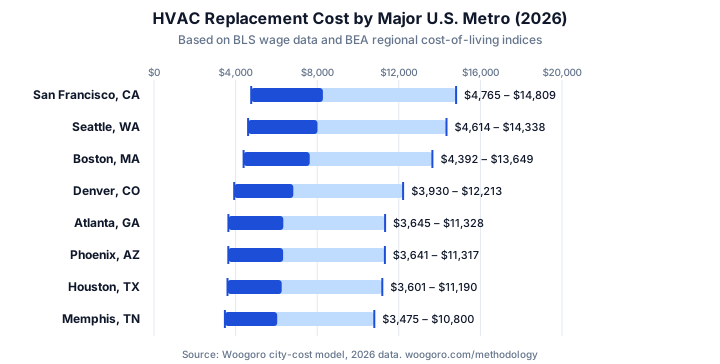
HVAC labor rates vary by metro because licensed HVAC labor scales with local construction wages and refrigerant-handling certification. The table below shows the typical AC + gas furnace combo system range for a 2,000 sqft home in each city, plus the variance vs. the U.S. median. Click any city for full local pricing.
| City | AC + Furnace Combo | vs. National Median |
|---|---|---|
| Atlanta, GA | $10,650-$14,550 | ~3% lower |
| Austin, TX | $11,000-$15,000 | at median |
| Baltimore, MD | $11,550-$15,750 | ~5% higher |
| Boston, MA | $13,400-$18,300 | ~22% higher |
| Charlotte, NC | $10,450-$14,250 | ~5% lower |
| Chicago, IL | $11,550-$15,750 | ~5% higher |
| Columbus, OH | $10,200-$13,950 | ~7% lower |
| Dallas, TX | $10,650-$14,550 | ~3% lower |
| Denver, CO | $11,550-$15,750 | ~5% higher |
| Detroit, MI | $10,450-$14,250 | ~5% lower |
| Houston, TX | $10,650-$14,550 | ~3% lower |
| Indianapolis, IN | $10,200-$13,950 | ~7% lower |
| Jacksonville, FL | $10,450-$14,250 | ~5% lower |
| Kansas City, MO | $10,200-$13,950 | ~7% lower |
| Las Vegas, NV | $11,200-$15,300 | ~2% higher |
| Los Angeles, CA | $13,400-$18,300 | ~22% higher |
| Memphis, TN | $9,700-$13,200 | ~12% lower |
| Miami, FL | $11,000-$15,000 | at median |
| Milwaukee, WI | $10,650-$14,550 | ~3% lower |
| Minneapolis, MN | $11,300-$15,450 | ~3% higher |
| Nashville, TN | $10,450-$14,250 | ~5% lower |
| New York, NY | $14,300-$19,500 | ~30% higher |
| Philadelphia, PA | $11,550-$15,750 | ~5% higher |
| Phoenix, AZ | $10,800-$14,700 | ~2% lower |
| Portland, OR | $11,550-$15,750 | ~5% higher |
| Raleigh, NC | $10,450-$14,250 | ~5% lower |
| San Antonio, TX | $10,450-$14,250 | ~5% lower |
| San Diego, CA | $12,950-$17,700 | ~18% higher |
| San Francisco, CA | $14,500-$19,800 | ~32% higher |
| Seattle, WA | $12,300-$16,800 | ~12% higher |
See HVAC pricing in 1,000+ U.S. cities → or browse the full HVAC cost guide for material deep-dives.
How to Get the Best HVAC Quote
- Insist on a Manual J load calculation. Manual J is the industry-standard heat-load calculation. Any installer who quotes by square-foot rule of thumb is guessing. Wrong-size systems cost more, run worse, and fail earlier.
- Decide on system type before quoting. Central AC + furnace, heat pump, or mini-split. Ask all three contractors to quote the same system type for a fair comparison.
- Get 3 written quotes from licensed HVAC contractors. Itemized, on letterhead, with a quote-valid-through date. Verify EPA 608 certification and state HVAC license.
- Verify line items match. Same tonnage, same SEER2 and AFUE, same indoor/outdoor pairing (AHRI certificate), same line-set replacement, same ductwork scope, same warranty terms.
- Confirm tax credit eligibility in writing. Federal 25C requires specific qualifying models. Get the AHRI certificate number on the contract so you can claim the credit at tax time.
- Confirm permit responsibility. The contractor pulls the permit. If they ask the homeowner to pull, that is a licensing red flag.
- Pay schedule sanity-check. 25-50 percent deposit is normal. Anything over 50 percent up front, or full payment before final inspection, is a red flag.
- Schedule final inspection and final payment after pass. Permit final inspection confirms the work meets code. Hold final payment until the inspection passes.
HVAC Quote Red Flags
- Square-foot sizing without Manual J. Industry shorthand of "500 sqft per ton" oversizes most homes by 25-50 percent. Oversized systems short-cycle, dehumidify poorly, and fail in 8-10 years instead of 15.
- Reused old line set when AC swap. Old line sets contaminated with mineral oil destroy compressors when paired with new POE-oil R-410A or R-454B refrigerants. Insist on new line set or proper flush.
- No permit pulled. Unpermitted HVAC work fails on home sale, voids warranty, and is a code violation. Walk away.
- Lowballing SEER on the quote then upcharging at install. Bait-and-switch tactic. The quote says SEER2 16, the install is SEER2 14, and the difference is your problem.
- "10-year warranty" requiring annual service contracts. Some manufacturer warranties require professional annual maintenance with documentation. Some installer "extended" warranties require service contracts at marked-up rates. Read terms before assuming the warranty is unconditional.
- Mismatched indoor/outdoor units. Equipment efficiency claims (SEER2, HSPF2) only hold when the indoor and outdoor units are factory-matched. Insist on the AHRI certificate showing the rating for your specific pairing.
- Same-day pressure to sign. Legitimate contractors hold pricing 30 days. Same-day pressure correlates with inflated pricing.
- Cash-only or unusual payment methods. Anything that bypasses normal contractor accounting is fraud and warranty risk.
- Below-market quote (30%+ under others). Usually means smaller tonnage, lower SEER2, reused line sets, or unlicensed labor.
- "We can install today." Reputable HVAC installers schedule 1-3 weeks out. Same-day installs are usually inventory dumps or cut-corner jobs.
Common HVAC Upsells: Decoded
Some HVAC add-ons are worth the money. Some are pure margin. Watch for these.
| Upsell | Cost | Usually Needed? |
|---|---|---|
| UV light or air purifier | $500-$1,500 | Rarely. Marginal benefit for most homes. |
| Full ductwork replacement | $3,000-$7,000 | Verify with a duct-leakage test. Only if leakage is over 20%. |
| Duct cleaning at install | $300-$500 | Sometimes. Helpful if not cleaned in 5+ years. |
| Whole-house humidifier | $400-$800 | Sometimes. Useful in dry climates only. |
| Extended labor warranty | $500-$1,500 | Sometimes. Compare cost vs. risk; many warranties pay back on one repair. |
| Zoning system | $2,000-$5,000 | Rarely. Only for multi-story homes with uneven temps. |
| Surge protector | $200-$400 | Often. Cheap insurance against compressor damage from utility surges. |
| Smart thermostat upgrade | $200-$500 | Often. Pays back in 1-3 years through scheduling. |
Geothermal: The Premium Option
Geothermal heat pumps use the earth's constant temperature for heating and cooling. Highest upfront cost, lowest operating cost, longest lifespan.
| Home Size | Total Installed Cost | After 30% Tax Credit | Annual Savings vs Gas |
|---|---|---|---|
| Small (1,500 sqft) | $20,000-$30,000 | $14,000-$21,000 | $500-$1,000 |
| Medium (2,500 sqft) | $25,000-$40,000 | $17,500-$28,000 | $800-$1,500 |
| Large (3,500+ sqft) | $35,000-$45,000 | $24,500-$31,500 | $1,200-$2,000 |
30 percent federal 25D tax credit with no cap, through 2034. 20-25 year equipment lifespan. Ground loop lasts 50+ years. Best for long-term homeowners on lots that support horizontal trenching or vertical bores.
How Much Can You Save on HVAC?
Realistic savings levers, ranked by effort vs. payoff:
- Get 3 quotes (saves 10-25%). Single-quote homeowners pay roughly 20 percent above market for HVAC. Highest-ROI move.
- Stack federal credits and state/utility rebates. A heat pump with $2,000 federal 25C plus a $1,500-$3,000 state or utility rebate can shave $4,000+ off net cost. Confirm eligibility before signing.
- Replace AC and furnace together (saves $1,500-$3,000). One truck roll, one permit, shared refrigerant lines. If either is over 12 years old, replacing both is the better long-term deal.
- Mid-tier brand, premium installer. A Rheem or Bryant installed by a top-tier crew outperforms a Carrier installed by a discount shop. Pay for the installer.
- Off-season scheduling (saves 5-15%). Spring (April-May) and fall (September-October) are slower months for HVAC contractors. Pricing softens.
- Skip variable-speed if not needed. Two-stage and variable-speed systems cost $1,500-$4,000 more. Worth it in humid climates and large homes; marginal in mild climates.
- SEER2 16-18 instead of 20+ (saves $1,500-$3,500). 16-18 is the sweet spot. 20+ only pays back in hot climates with 10+ year stays.
- Annual maintenance (saves long-term). $150-$300 per year extends system life 30-50 percent. Skipping maintenance is the most common reason for premature failure.
HVAC FAQ
How much does HVAC replacement cost in 2026?
HVAC replacement costs $4,000 to $25,000 in 2026 depending on system type. Central AC alone runs $5,000 to $10,000. Gas furnace alone runs $4,000 to $8,000. A combo AC plus furnace runs $7,000 to $15,000. Heat pumps run $7,000 to $25,000 (cold-climate models cost more). Ductless mini-splits run $4,000 to $15,000. Geothermal runs $20,000 to $45,000. New ductwork adds $5,000 to $15,000.
Should I replace AC and furnace at the same time?
Yes if either is over 12 years old. HVAC systems are sized as a matched pair; mismatched ages and SEER ratings reduce efficiency 10 to 20 percent. Replacing together also saves $1,500 to $3,000 in labor (one truck roll, one permit, shared refrigerant lines). Most installers will pro-rate parts of the working unit toward the new bid.
How long does an HVAC system last?
Central AC: 12 to 15 years (Northern climates) or 8 to 12 years (humid Southern climates). Furnaces: 15 to 20 years for gas, 20 to 30 years for electric. Heat pumps: 10 to 15 years. Mini-splits: 15 to 20 years. Geothermal heat pumps: 20 to 25 years (ground loop lasts 50+ years). Annual maintenance ($150 to $300) typically extends lifespan 30 to 50 percent.
Is a heat pump cheaper than a gas furnace?
Heat pumps cost $1,500 to $3,000 more upfront than gas furnaces but cost 30 to 50 percent less to operate in mild and moderate climates. Federal 25C tax credits ($2,000 for heat pumps, $600 for AC, $600 for furnace) plus state and utility rebates may apply through 2032 under the Inflation Reduction Act. Geothermal heat pumps qualify for the 30 percent 25D credit through 2034. In cold climates (below zone 4), pair a heat pump with a small gas backup (dual fuel) for full-winter coverage.
What SEER2 rating should I buy?
SEER2 14-15 is the minimum federal standard in 2026 (varies by region). SEER2 16-18 is the sweet spot for most homes, about $1,000 to $2,000 more than minimum, with energy savings paying back in 4 to 7 years. SEER2 20+ ultra-high-efficiency units only make sense in hot climates or homes with very high cooling loads. SEER2 replaced SEER in 2023 and is calculated using more realistic test conditions; SEER2 numbers are roughly 4.5 percent lower than the old SEER for the same equipment.
Why is HVAC so expensive in 2026?
HVAC pricing is up 25 to 40 percent since 2022 due to refrigerant transition (R-410A to R-454B and R-32), supply chain costs, and continued labor shortage in skilled HVAC trades. Federal SEER minimums rose in 2023 (SEER2 standard), forcing equipment redesigns. The labor shortage alone has pushed installer hourly rates up 15 to 30 percent.
Can I install HVAC myself?
No, not legally for full systems. HVAC installation requires EPA Section 608 certification to handle refrigerant, plus state HVAC contractor licensing in most states. DIY mini-split installs without refrigerant work (line-set vacuum-pumping done by a pro) are common, but full system DIY voids manufacturer warranty and risks refrigerant fines of $25,000+ from EPA. Even DIY mini-splits should be commissioned by a licensed installer for warranty validity.
How long does an HVAC install take?
AC swap (replacing existing equipment, no ductwork changes): 1 day. Combo AC plus furnace replacement: 1 to 2 days. New mini-split (1 to 3 zones): 1 to 2 days. New ductwork install: 3 to 5 days. Geothermal install: 1 to 3 weeks (ground loop drilling adds time). Permits and inspections add 1 to 3 weeks before work starts and 1 to 2 weeks after for final inspection.
See if your HVAC quote is fair
Upload your contractor quote and we'll compare it against city wage data, flag missing scope, and tell you the realistic price range for your exact project. Free, no email required.
How We Calculate HVAC Costs
Every per-system and per-city range on this page is built from three public datasets: Bureau of Labor Statistics Occupational Employment and Wage Statistics for heating, air conditioning, and refrigeration mechanics and installers, Bureau of Economic Analysis Regional Price Parities for material adjustments, and 2026 retail equipment pricing from major U.S. HVAC distributors and manufacturer dealer networks. Ranges represent the middle 60-70 percent of typical residential quotes, not the extremes. Read our full methodology for details on how city multipliers are derived.