

Got a solar quote?
Upload it and we'll check the per-watt price against city wage data, flag dealer-fee markup, oversizing, and TPO/PPA traps. Free, no email.
Average Solar Cost by System Size (2026)
Solar pricing scales nearly linearly with system size in kW DC. The table below shows installed cost by typical residential system size at standard ($2.50-$3.00/W) and premium ($3.00-$3.80/W) tiers, plus the after-30%-tax-credit net.
| System Size | Standard Tier | Premium Tier | After 30% Tax Credit |
|---|---|---|---|
| 5 kW (~$100/mo bill) | $12,500-$15,000 | $15,000-$19,000 | $8,750-$13,300 |
| 6 kW (~$120/mo bill) | $15,000-$18,000 | $18,000-$22,800 | $10,500-$15,960 |
| 8 kW (~$160/mo bill) | $20,000-$24,000 | $24,000-$30,400 | $14,000-$21,280 |
| 10 kW (~$200/mo bill) | $25,000-$30,000 | $30,000-$38,000 | $17,500-$26,600 |
| 12 kW (~$240/mo bill) | $30,000-$36,000 | $36,000-$45,600 | $21,000-$31,920 |
| Battery (Tesla Powerwall 3) | $10,000-$16,000 installed | $7,000-$11,200 net | |
| Battery (Enphase IQ Battery 5P) | $12,000-$18,000 installed | $8,400-$12,600 net | |
| Battery (FranklinWH aPower 2) | $13,000-$20,000 installed | $9,100-$14,000 net | |
Pricing includes panels, inverter, racking, wiring, permits, inspection, and interconnection. Tree removal, panel upgrades, and roof replacement are usually quoted separately. State and utility rebates can reduce net cost another 10 to 30 percent on top of the federal credit.
Solar Cost by Per-Watt Pricing
The clearest apples-to-apples comparison between solar quotes is dollars per watt DC installed, before the tax credit. National median is roughly $3.00 per watt; quotes above $4.00/W almost always include heavy dealer-fee markup or premium-brand bundles. Quotes under $2.50/W usually skip permitting or use Tier 2 panels.
| Per-Watt Range | What You're Getting | Notes |
|---|---|---|
| $2.20-$2.50/W | Cash, Tier 1 panels, no premium brand | Best price, often local installer with low overhead |
| $2.50-$3.00/W | Cash or HELOC, Tier 1 panels, mid-tier inverter | National median. Most common range. |
| $3.00-$3.50/W | Premium panels (REC, Q-Cells, LG) or microinverters | Solid value if you want the upgrade |
| $3.50-$4.00/W | Premium panels + microinverters + financing dealer fee | Dealer fee 10-15% baked in. Negotiable. |
| $4.00+/W | SunPower or premium bundle, or heavy dealer-fee financing | Often 20-30% dealer-fee markup. Get other quotes. |
Panel Types: Monocrystalline vs. Polycrystalline vs. Thin-Film
Panel choice is one of three major line items in your quote (panels, inverter, mounting). Most residential systems in 2026 use monocrystalline panels because polycrystalline has been phased out by all major manufacturers.
- Monocrystalline ($2.50-$3.80/W installed): 19-22 percent efficiency, black aesthetic, 25-year power warranty. The default residential choice. Top brands: REC Alpha Pure, Q-Cells Q.Peak DUO, Panasonic EverVolt, SunPower Maxeon (premium), LG (discontinued but stockpiled).
- Polycrystalline (mostly discontinued): 15-17 percent efficiency, blue-flecked aesthetic, cheaper but rarely sold new in the U.S. since 2023. If a quote offers polycrystalline at a substantial discount, check the manufacturer warranty status.
- Thin-film (rare residential): 10-13 percent efficiency, requires more roof area, lower cost per watt. Almost exclusively used in commercial and utility-scale, not residential.
- Panel tiers: Tier 1 manufacturers (Bloomberg ranking) have the financing and warranty backing to honor 25-year claims. Tier 2 and Tier 3 panels are cheaper but bankruptcy risk on a 25-year warranty is real. Insist on Tier 1.
Premium panels (SunPower Maxeon, REC Alpha Pure-RX) cost roughly 15 to 25 percent more than mainstream Tier 1 (Q-Cells, Canadian Solar, Trina) but the production gap is usually 5 to 10 percent. Mainstream Tier 1 is the value sweet spot for most homes.
Inverter Types: String vs. Microinverter vs. Power Optimizer
The inverter converts panel DC power to AC for your home. Inverter choice affects production, monitoring granularity, warranty, and price. Three architectures dominate residential.
- String inverter ($0.10-$0.20/W in installed system cost): One central inverter for the whole array. Cheapest. Lower production if any panel is shaded because the whole string drops to the lowest-producing panel's output. 10 to 15 year warranty typical. Top brands: SMA, Fronius, Sungrow.
- Microinverter ($0.30-$0.50/W premium): One small inverter per panel. Best for shaded or complex roofs because each panel operates independently. Per-panel monitoring. 25-year warranty matches panel warranty. Industry standard: Enphase IQ8.
- Power optimizer + string ($0.20-$0.35/W premium): Hybrid system. Power optimizer at each panel maximizes output, but a single inverter on the wall does the DC-to-AC conversion. Per-panel monitoring. 25-year optimizer warranty, 12-year inverter warranty. Industry standard: SolarEdge.
For a clean south-facing unshaded roof, string is fine and cheapest. For shaded roofs, multiple roof faces, or if you value granular monitoring, microinverters or SolarEdge optimizers are worth the upcharge. Required California Rule 21 rapid-shutdown is built into both microinverters and SolarEdge.
Roof vs. Ground Mount, and Battery Storage
Most residential solar is roof-mount. Ground-mount and battery storage are growing categories but each has trade-offs.
- Roof mount ($2.50-$3.80/W): Default. Works on most asphalt-shingle, metal, and tile roofs. South-facing is best, east and west are 80 to 90 percent of south production, north should be avoided.
- Ground mount ($2.90-$4.20/W): For homes with shaded or unsuitable roofs but available yard space. Higher installation cost (concrete footings, conduit run to home) but enables optimal panel orientation. Common in rural and semi-rural lots.
- Battery storage ($10,000-$20,000 installed for ~10 kWh): Tesla Powerwall 3 (13.5 kWh, $10,000-$16,000), Enphase IQ Battery 5P (5 kWh, $7,000-$10,000 each, often stacked), FranklinWH aPower 2 (15 kWh, $13,000-$20,000). All qualify for the 30 percent federal tax credit. Worth it where utility outages are frequent, time-of-use rates apply, or net metering has been eliminated (CA NEM 3.0).
- Federal 30% ITC (Inflation Reduction Act): Locked in through 2032. Applies to panels, inverters, mounting, battery (paired or standalone), and labor. Non-refundable but rolls forward 5 years.
- State SRECs and net metering: NJ, MD, MA, DC, IL, OH, PA, DE have SREC markets that pay $50-$300 per MWh. Net metering varies by state and is being rolled back in CA, NV, and a few others. Check DSIRE for state-specific incentives.
What Should a Solar Quote Include?
Itemized quotes are the only way to compare solar fairly. Round-number quotes ("$25,000 turnkey") hide dealer-fee markup, panel substitution, and warranty differences. A complete solar quote should list every line below.
- System size in kW DC (panel count x panel wattage)
- Panel brand, wattage, and quantity (e.g., 24 x REC Alpha Pure-R 410W)
- Inverter brand, model, and architecture (string, microinverter, or power optimizer)
- Racking and mounting system (IronRidge, Unirac, etc.)
- Roof penetration count and flashing details
- Wiring, conduit, and rapid-shutdown compliance
- Main service panel inspection and any required upgrade ($1,300-$3,500 separately if 100A is current)
- Monitoring system (manufacturer's app, included for life)
- Permits and AHJ inspection fees
- Utility interconnection application and fees ($50-$1,500 to utility)
- Production guarantee in kWh per year (recommended 90% of model)
- Panel warranty (25-year product, 25-year power, 80-85% at year 25)
- Inverter warranty (10-25 years depending on type)
- Workmanship warranty (10 years is standard, 25 years on premium)
- Battery storage details (if included): brand, kWh capacity, warranty
- Tree removal allowance (if shading is an issue)
- Cleanup and roof inspection post-install
- Total cash price AND total financed price (with all fees disclosed)
Hidden Solar Costs Most Homeowners Miss
Solar quote surprises mostly come from a few recurring traps. Watch for these.
- Main service panel upgrade ($1,300-$3,500): Older homes with 100 amp service often need a 200 amp upgrade. Almost never bundled into the solar quote.
- Tree removal for shading ($500-$3,000 per tree): Shading kills solar production. The installer's site visit should identify trees that need to come down. Removal is the homeowner's responsibility.
- Roof replacement before solar ($8,000-$25,000): Don't put 25-year panels on a 10-year roof. If your roof has under 10 years of remaining life, replace it first. Removing and reinstalling panels for a future re-roof costs $2,000-$5,000.
- Critter guard ($500-$1,500): Mesh skirt around the panel array to keep squirrels and birds out. Often left out of base quotes; squirrel chewing is a top warranty-claim cause.
- Monitoring subscription: Most manufacturer monitoring is free for life (Enphase Enlighten, SolarEdge mySolarEdge). Watch for third-party monitoring add-ons that charge a monthly fee.
- Interconnection fees ($50-$1,500): Paid to your utility for net metering enrollment and the bidirectional meter swap. Highly variable by utility.
- Dealer fee on financed solar (10-30%): Built into financed price, hidden from cash quote. A $25,000 cash quote often becomes $30,000-$32,500 financed at the same APR. Always ask for the cash price first.
- Property tax reassessment: 30 states exempt residential solar from property tax. Check your state. Where it isn't exempt, expect $200-$800/year in additional property tax.
- HOA review fee ($50-$300): Many HOAs charge for solar installation review. CA, AZ, NV, and a few others bar HOAs from blocking solar but they can still demand aesthetics review.
Solar Cost by City
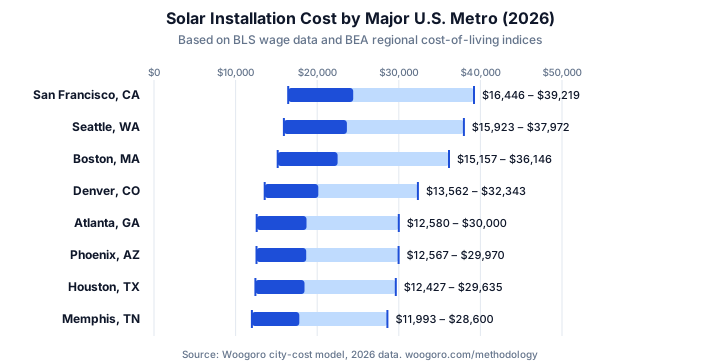
Solar labor rates vary by metro because solar PV installers, electrical contractors, and permitting fees scale with local construction wages. Below are 30 U.S. cities with their typical 8 kW installed system range and the variance vs. the U.S. median.
| City | 8 kW System (Pre-Credit) | vs. National Median |
|---|---|---|
| Atlanta, GA | $21,800-$26,200 | ~3% lower |
| Austin, TX | $22,500-$27,000 | at median |
| Baltimore, MD | $23,600-$28,350 | ~5% higher |
| Boston, MA | $27,450-$32,940 | ~22% higher |
| Charlotte, NC | $21,375-$25,650 | ~5% lower |
| Chicago, IL | $23,600-$28,350 | ~5% higher |
| Columbus, OH | $20,925-$25,110 | ~7% lower |
| Dallas, TX | $21,800-$26,200 | ~3% lower |
| Denver, CO | $23,600-$28,350 | ~5% higher |
| Detroit, MI | $21,375-$25,650 | ~5% lower |
| Houston, TX | $21,800-$26,200 | ~3% lower |
| Indianapolis, IN | $20,925-$25,110 | ~7% lower |
| Jacksonville, FL | $21,375-$25,650 | ~5% lower |
| Kansas City, MO | $20,925-$25,110 | ~7% lower |
| Las Vegas, NV | $22,950-$27,540 | ~2% higher |
| Los Angeles, CA | $27,450-$32,940 | ~22% higher |
| Memphis, TN | $19,800-$23,760 | ~12% lower |
| Miami, FL | $22,500-$27,000 | at median |
| Milwaukee, WI | $21,800-$26,200 | ~3% lower |
| Minneapolis, MN | $23,175-$27,810 | ~3% higher |
| Nashville, TN | $21,375-$25,650 | ~5% lower |
| New York, NY | $29,250-$35,100 | ~30% higher |
| Philadelphia, PA | $23,600-$28,350 | ~5% higher |
| Phoenix, AZ | $22,050-$26,460 | ~2% lower |
| Portland, OR | $23,600-$28,350 | ~5% higher |
| Raleigh, NC | $21,375-$25,650 | ~5% lower |
| San Antonio, TX | $21,375-$25,650 | ~5% lower |
| San Diego, CA | $26,550-$31,860 | ~18% higher |
| San Francisco, CA | $29,700-$35,640 | ~32% higher |
| Seattle, WA | $25,200-$30,240 | ~12% higher |
See solar pricing in 1,000+ U.S. cities → or browse the full solar cost guide for material deep-dives.
How to Get the Best Solar Quote
- Pull 12 months of electric bills first. Calculate your annual kWh. Without this, every quote is guessing and most will oversize for commission.
- Inspect your roof and electrical panel. Note roof age, shading, and your main service panel size. These are prerequisite costs not in the solar quote.
- Get 3 written quotes from NABCEP-certified or state-licensed installers. Reject "free solar" marketing (it's a lease). Local installers usually beat national companies on price by 15-25 percent.
- Compare per-watt pricing. Dollars per watt DC installed is the apples-to-apples comparison. Anything over $4.00/W deserves a hard look.
- Verify line items match. Same system size, same panel brand and wattage, same inverter type, same warranty terms.
- Demand the cash price separately from the financed price. Dealer fees on financed solar are 10 to 30 percent and hidden in the financed quote.
- Ask for the production guarantee in writing. 90 percent of modeled production is reasonable. No guarantee means walk away.
- Verify TPO/PPA status. If the contract is 20 to 25 years and the company owns the panels, it's a lease. Owned solar is the only path to home-value uplift.
Solar Quote Red Flags
- "Free solar." It's a lease (TPO or PPA). 20-25 year lock-in, zero home-value uplift, complicates future home sale.
- Inflated savings projections. Quotes that assume 5-7 percent annual electric rate increases for 25 years are gaming the math. National average is 2-3 percent.
- No production guarantee. Reputable installers guarantee 90 percent of modeled kWh per year. No guarantee means they don't trust their own model.
- Oversized system padded for commission. Sales reps earn on system size. If your annual usage is 9,000 kWh and they're quoting a 12 kW system that produces 14,000 kWh, you're paying for excess production you can't monetize under modern net metering.
- Dealer-fee markup buried in financing. The 10-30 percent fee shows up only on the financed quote. Always ask for the cash price.
- "Our financing is 0% APR." The APR is on the financed amount, but the dealer fee inflates the principal. True effective APR is usually 6-12 percent.
- Tier 2 panels with no clear warranty backing. Bankruptcy risk on a 25-year warranty is real. Insist on Bloomberg Tier 1 panel manufacturers.
- "Sign today and save $5,000." Legitimate installers hold pricing 30 days. High-pressure tactics correlate with worse contracts.
- No interconnection commitment. Installer should pull the interconnection application. If they make you do it, they may not be properly licensed.
- Below-market quotes (30%+ under others). Usually skipping permits, using Tier 2 panels, or unlicensed labor. Verify NABCEP certification.
Permits, Interconnection, and Federal Tax Credit
Every grid-tied solar installation requires a building permit and an electrical permit, plus an interconnection agreement with your utility. The installer pulls all three. Permit fees range $300-$1,500 depending on jurisdiction. Interconnection takes 4-12 weeks after install.
Three things bind every solar job:
- Federal 30% Investment Tax Credit. Inflation Reduction Act, locked through 2032. Applies to panels, inverter, racking, batteries (paired or standalone), and labor. Non-refundable but rolls forward 5 tax years. Claimed on IRS Form 5695. Consult a tax pro on your specific situation.
- NABCEP certification. The North American Board of Certified Energy Practitioners certifies solar PV installers. Required by many state rebate programs and increasingly by the federal credit. Verify by name lookup at NABCEP.org.
- Utility interconnection agreement. Your utility must approve the system and issue a Permission to Operate (PTO) before you can turn it on. Some utilities have application backlogs of 8-16 weeks. The installer should manage this and warn you about local backlog.
State and utility incentives stack on top of the federal credit. Check the DSIRE database for your zip code; many states offer additional rebates of $500-$5,000 plus performance-based SREC payments.
How Much Can You Save on Solar?
Realistic savings levers, ranked by effort vs. payoff:
- Get 3 quotes from local installers (saves 15-30%). Local installers routinely beat national brands like SunRun and Sunnova by 15-25 percent on the same equipment. Highest-ROI move.
- Pay cash or HELOC instead of dealer financing (saves 10-30%). Dealer fees are huge. Cash, HELOC, or unsecured personal loan at 7-9% APR usually beats dealer financing at "0%" APR.
- Right-size the system, don't oversize. Aim for 90 to 100 percent annual offset. Oversizing past 100 percent rarely earns full retail credit and adds $3,000-$8,000 of unnecessary cost.
- Mainstream Tier 1 panels instead of premium (saves 10-20%). Q-Cells and Canadian Solar perform within 5-10 percent of SunPower and REC Alpha at 15-25 percent less cost.
- String inverter on simple roofs (saves $0.30/W). Microinverters earn their premium on shaded or complex roofs. Clean south-facing arrays don't need them.
- Skip the battery (saves $10,000-$20,000). Unless you have frequent outages, time-of-use rates, or NEM 3.0, grid-tied solar without battery has better economics.
- Bundle panel upgrade and roof replacement. If both are needed, bundling with the solar install saves 5-10 percent and avoids re-mobilization charges.
- Stack state and utility rebates. Check DSIRE. Some states still offer $1,000-$5,000 in additional cash rebates on top of the federal credit.
Solar Panel Installation FAQ
How much does a solar panel system cost in 2026?
Residential solar costs $15,000 to $38,000 before incentives in 2026 depending on system size. A typical 6 kW system runs $15,000 to $23,000 before the federal tax credit, $10,500 to $16,100 after. An 8-10 kW system runs $20,000 to $38,000 before, $14,000 to $26,600 after the 30 percent federal Investment Tax Credit. Per-watt pricing averages $2.50 to $3.80 installed for rooftop and $2.90 to $4.20 for ground-mount arrays.
How long does it take for solar to pay back?
Most U.S. homes see solar payback in 7 to 12 years after the federal tax credit. Sunny states with high electricity rates (CA, AZ, NV, FL, MA) hit 5 to 8 year payback. Cloudy or low-rate states (WA, KY, ID) hit 12 to 18 year payback. After payback, panels generate effectively free electricity for the remaining 15 to 25 years of their useful life. Production guarantees typically warranty 80 to 85 percent of original output at year 25.
Should I buy solar or lease (PPA)?
Buy if at all possible. Owned solar adds $4 to $6 per installed watt to home value (about $20,000 to $40,000 for a 6 to 10 kW system) and you keep the 30 percent federal tax credit. Leased solar (TPO/PPA) adds zero to home value and the lease can complicate or kill a future home sale. "Free solar" marketing is a lease in disguise. Avoid 20 to 25 year lease lock-ins unless you are certain you will stay in the home that long.
Can I install solar panels myself?
DIY solar saves $5,000 to $10,000 on a typical install but is rarely worth it. You lose the manufacturer warranty, lose access to most state rebates, may void homeowner insurance, and the federal tax credit requires NABCEP-certified installers in most states. Most DIYers buy permitting, electrical, and roof penetration done by a pro and DIY only the panel mounting.
How much electricity will my solar system produce?
A 6 kW solar system in a sunny U.S. location produces 7,000 to 9,000 kWh per year; a 10 kW system produces 12,000 to 15,000 kWh per year. Cloudy regions produce 30 percent less. Production drops 0.5 to 0.8 percent per year as panels age. Most homeowners size systems to offset 90 to 100 percent of annual electric use; sizing above 100 percent rarely earns full retail credit under modern net metering rules.
Should I get a battery with my solar?
Batteries (Tesla Powerwall, Enphase IQ, FranklinWH) cost $10,000 to $20,000 installed but qualify for the 30 percent federal tax credit and provide outage backup. Worth it if your area has frequent outages, your utility has time-of-use rates, or your utility eliminated net metering (CA NEM 3.0). Otherwise, grid-tied solar without batteries usually has better economics.
What is the federal solar tax credit in 2026?
The federal Investment Tax Credit (ITC) is 30 percent in 2026, locked in through 2032 by the Inflation Reduction Act. It applies to panels, inverters, mounting, batteries (paired or standalone), and labor. The credit is non-refundable but rolls forward up to 5 years. State and utility rebates are typically stacked on top, often reducing net cost another 10 to 30 percent. Confirm state-specific incentives at the DSIRE database.
Will solar panels need a panel upgrade or roof replacement first?
Maybe. Older homes with 100 amp main service panels often need a 200 amp upgrade ($1,300 to $3,500) before solar. Roofs with under 10 years of remaining life should be replaced before installing 25-year solar panels because removing and reinstalling panels for a future re-roof costs $2,000 to $5,000. A reputable solar installer will inspect the panel and roof condition during the site visit and disclose any prerequisite work.
See if your solar quote is fair
Upload your contractor quote and we'll compare per-watt price against city wage data, flag dealer-fee markup, oversizing, and TPO/PPA traps. Free, no email required.
How We Calculate Solar Costs
Every per-watt and per-system range on this page is built from three public datasets: Bureau of Labor Statistics Occupational Employment and Wage Statistics for solar photovoltaic installers and electricians, Bureau of Economic Analysis Regional Price Parities for material adjustments, and 2026 retail material pricing from major U.S. solar distributors and manufacturers (REC, Q-Cells, Enphase, SolarEdge, Tesla, FranklinWH). Ranges represent the middle 60-70% of typical residential quotes, not extremes. Read our full methodology for details on how city multipliers are derived.