

Got a roofing quote?
Upload it and we'll check the price against city wage data and flag missing scope items. Free, no email.
Average Roof Cost by Material (2026)
The single biggest pricing lever on a roof quote is material choice. The table below shows installed cost per square foot for the most common residential roof types, plus a typical 2,000 sqft house total and what each material is best for.
| Material | Per Square Foot | 2,000 sqft House | Best For |
|---|---|---|---|
| Asphalt 3-tab shingle | $3.50-$5.50/sqft | $7,000-$11,000 | Tightest budget, 15-20 year lifespan |
| Architectural shingle | $5-$8/sqft | $10,000-$16,000 | Most common today, 25-30 year lifespan |
| Cedar shake | $7-$12/sqft | $14,000-$24,000 | Rustic look, 30-40 year lifespan with maintenance |
| Standing-seam metal | $8-$14/sqft | $16,000-$28,000 | 40-70 year lifespan, heat reflection, hail resistance |
| Metal panel (R-panel, exposed fastener) | $6-$10/sqft | $12,000-$20,000 | Budget metal, 30-40 year lifespan |
| Concrete tile | $10-$15/sqft | $20,000-$30,000 | Hot/dry climates, 50-75 year lifespan |
| Clay tile | $12-$18/sqft | $24,000-$36,000 | Premium look, 75-100 year lifespan |
| Slate | $20-$35/sqft | $40,000-$70,000+ | Historic homes, 100+ year lifespan |
| Flat roof (TPO/EPDM) | $5-$11/sqft | $10,000-$22,000 | Low-pitch additions, 20-30 year lifespan |
Prices include tear-off of one existing layer, new underlayment, drip edge, ice-and-water shield (cold climates), ridge vent, flashing, and standard labor on a 4/12 to 8/12 pitch. Steep pitch (9/12+) adds 15-30%; second tear-off layer adds $0.50-$1.50/sqft.
Roof Cost by House Size
Roof pricing scales with the surface area being covered, not floor area. A typical 4/12 to 8/12 pitch roof covers ~1.15x to 1.40x the floor footprint. Below are typical total costs for the three most common roofing materials at standard residential house sizes.
| House Floor Area | Asphalt Architectural | Standing-Seam Metal | Concrete Tile |
|---|---|---|---|
| 1,000 sqft (small ranch) | $5,500-$9,500 | $9,000-$16,000 | $11,000-$18,000 |
| 1,500 sqft (typical 3-bedroom) | $7,500-$13,500 | $13,000-$22,000 | $16,000-$26,000 |
| 2,000 sqft (typical suburban) | $10,000-$16,000 | $16,000-$28,000 | $20,000-$32,000 |
| 2,500 sqft (large suburban) | $12,500-$20,000 | $20,000-$36,000 | $26,000-$40,000 |
| 3,500 sqft (executive) | $17,500-$28,000 | $28,000-$50,000 | $36,000-$56,000 |
Steeper pitches, complex hip/valley counts, dormers, skylights, and chimney count all push costs above these ranges. A simple gable roof on a rectangular house lands at the low end; a heavy hip-roof with multiple dormers lands at the high end.
Asphalt Shingle Cost: 3-Tab vs. Architectural vs. Designer
Asphalt shingle covers about 75% of U.S. residential roofs. The three common grades each have a clear pricing and longevity profile.
- 3-tab shingle ($3.50-$5.50/sqft installed): Cheapest asphalt option. Flat single-tab profile. 15-20 year warranty. Most insurance carriers in hail-prone regions (Texas, Colorado, Oklahoma) now refuse to insure 3-tab. Use only on rentals, sheds, or extreme-budget projects.
- Architectural / laminated shingle ($5-$8/sqft installed): The default mid-range choice today. Dimensional shadow profile, two layers laminated. 25-30 year warranty. Brands: GAF Timberline HDZ, CertainTeed Landmark, Owens Corning Duration. Class 4 impact-resistant variants get 5-25% homeowner insurance discount.
- Designer / luxury shingle ($8-$14/sqft installed): Premium grade. Mimics slate or wood shake at half the cost. 50-year warranty. Brands: GAF Camelot II, CertainTeed Grand Manor. Used on architectural homes where appearance matters more than budget.
For a 2,000 sqft house, expect to pay roughly $4,000 more for architectural than 3-tab, and another $5,000-$8,000 more for designer. Lifetime cost almost always favors architectural for the typical 10-20 year homeowner stay.
Metal Roof Cost: Standing Seam vs. Exposed Fastener
Metal roofing costs $6-$14 per square foot installed, depending on the panel type. Standing-seam costs $8-$14/sqft and is what most homeowners think of when they say "metal roof". Exposed-fastener (R-panel, ribbed-metal) is cheaper at $6-$10/sqft and is more common on barns, garages, and budget residential builds.
- Standing-seam metal ($8-$14/sqft): Vertical panels with concealed fasteners. 40-70 year lifespan. Sheds snow and ice perfectly. Available in 24-gauge or 26-gauge steel, aluminum, copper, or zinc. Most premium aesthetic.
- Exposed-fastener metal ($6-$10/sqft): Ribbed panels (R-panel, U-panel, PBR) screwed through the face. Fasteners need re-tightening every 10-15 years. 30-40 year lifespan. Common on outbuildings.
- Stone-coated steel ($9-$13/sqft): Looks like asphalt or shake but lasts 50+ years. Common in hail and wildfire regions.
- Copper ($18-$30/sqft): Premium. Patinas to green over 15-25 years. Used as accent roofing on dormers and bay windows. 100+ year lifespan.
Lifetime cost favors metal for homeowners staying 20+ years. The 2x-3x upfront premium over asphalt is offset by the 40-70 year lifespan and lower insurance premiums in hail-prone or wildfire regions.
Tile and Slate Roof Cost: Premium and Specialty
Tile and slate are heavy, long-lifespan roofing options used primarily in hot/dry climates (concrete tile, clay tile) or on historic homes (slate). Both require structural verification - many older homes need engineering and additional rafters before accepting tile or slate weight.
- Concrete tile ($10-$15/sqft installed): 50-75 year lifespan. Common in California, Arizona, Florida, Nevada. Reflects heat well in hot climates.
- Clay tile ($12-$18/sqft installed): Premium look. 75-100 year lifespan. Spanish, Mediterranean, mission style.
- Slate ($20-$35/sqft installed): Genuine quarried stone. 100+ year lifespan. Used on historic and high-end homes. Replacement cost is the primary reason buyers choose insurance with a slate-specific endorsement.
- Synthetic slate ($10-$18/sqft installed): Polymer-composite. Looks similar to slate at half the price. 40-50 year lifespan. Lighter weight (no structural upgrade typically needed).
Verify your roof structure with an engineer before pricing tile or slate. Adding 7-10 lb/sqft of dead load to a roof not designed for it can cause framing failure under wind or snow loads.
What Should a Roofing Quote Include?
Itemized quotes are the only way to compare roofing contractors fairly. Round-number quotes ("$15,000 for the whole thing") hide the same scope omissions over and over. A complete roofing quote should list every line below.
- Roof area in squares (1 square = 100 sqft) and pitch
- Tear-off scope: number of existing layers, dump fee, plywood patch allowance
- Decking inspection and sheet-replacement allowance ($60-$95 per 4x8 sheet)
- Underlayment grade: synthetic (Tyvek, Titanium UDL) vs. 30# felt
- Ice-and-water shield: eaves only (3-6 ft) vs. full-perimeter vs. full deck
- Drip edge metal: gauge and color
- Shingle brand, line, color, and warranty
- Starter strip and ridge cap (factory-made vs. cut from shingles)
- Step flashing, valley flashing, chimney cricket, and pipe boot replacement
- Ridge vent or off-ridge attic ventilation count and CFM rating
- Permit pulled by contractor, in contractor's name
- Magnetic sweep cleanup of nails (yard, driveway, gutters)
- Disposal and dump fees
- Workmanship warranty (5-year minimum, 10-year is good)
- Manufacturer's material warranty (typical 25-50 years)
Hidden Roof Costs Most Homeowners Miss
Most roof-quote surprises come from a small set of recurring omissions. Watch for these before you sign.
- Decking replacement ($60-$95 per 4x8 sheet): Most quotes include 1-3 sheets free; rotten decking past that is billed separately. Houses 25+ years old typically need 5-15 sheets.
- Second-layer tear-off ($0.50-$1.50/sqft): If your roof has two layers, removal cost roughly doubles.
- Steep-pitch surcharge (15-30%): Anything over 8/12 pitch costs more in labor and safety.
- Ice-and-water shield upgrade: Eaves-only is the cheap default. Full-perimeter or full-deck adds $400-$1,500.
- Pipe boots, chimney cricket, skylight reflashing: Often quoted separately. $100-$400 each.
- Solar-panel detach-and-reset ($1,500-$4,500): If you have rooftop solar, the panels must come off and go back. Confirm the roofer does this in-house or hires a licensed PV crew.
- Gutter detach-and-reset ($300-$800): Required if drip edge is being replaced. Some roofers include it, some bill separately.
- Permit fee ($150-$500): Some contractors leave this off and ask you to pull it yourself.
- HOA color approval lead time: Not a cost but a schedule risk - some HOAs need 30-60 days to approve a new shingle color.
- Insurance scope mismatch: If working through a hail or wind claim, the contractor's pricing must match the insurer's Xactimate scope or you'll owe the difference.
Roof Cost by City
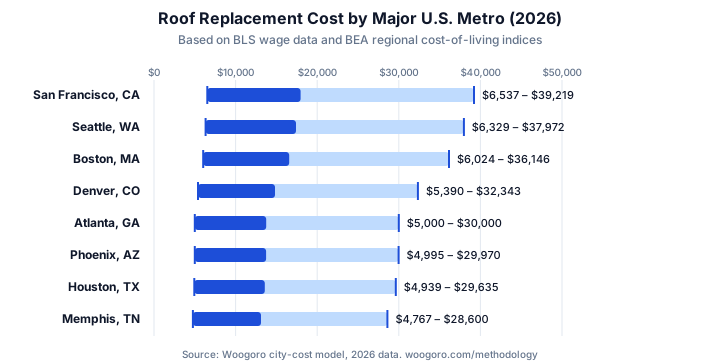
Roofing labor rates vary by metro because tear-off, decking, and steep-roof work scales with local construction wages. Below are 30 U.S. cities with their typical 2,000 sqft architectural-shingle roof range. Click through for the full city pricing breakdown.
| City | Architectural Shingle (2,000 sqft) | vs. National Median |
|---|---|---|
| Atlanta, GA | $9,500-$15,200 | ~3% lower |
| Austin, TX | $9,800-$15,600 | at median |
| Baltimore, MD | $10,400-$16,500 | ~5% higher |
| Boston, MA | $12,000-$19,000 | ~22% higher |
| Charlotte, NC | $9,300-$14,800 | ~5% lower |
| Chicago, IL | $10,400-$16,600 | ~5% higher |
| Columbus, OH | $9,100-$14,500 | ~7% lower |
| Dallas, TX | $9,500-$15,200 | ~3% lower |
| Denver, CO | $10,300-$16,400 | ~5% higher |
| Detroit, MI | $9,300-$14,800 | ~5% lower |
| Houston, TX | $9,500-$15,200 | ~3% lower |
| Indianapolis, IN | $9,100-$14,500 | ~7% lower |
| Jacksonville, FL | $9,300-$14,800 | ~5% lower |
| Kansas City, MO | $9,100-$14,500 | ~7% lower |
| Las Vegas, NV | $9,800-$15,700 | ~2% higher |
| Los Angeles, CA | $12,000-$19,000 | ~22% higher |
| Memphis, TN | $8,700-$13,800 | ~12% lower |
| Miami, FL | $9,800-$15,500 | at median |
| Milwaukee, WI | $9,500-$15,200 | ~3% lower |
| Minneapolis, MN | $10,200-$16,300 | ~3% higher |
| Nashville, TN | $9,300-$14,800 | ~5% lower |
| New York, NY | $13,000-$20,500 | ~30% higher |
| Philadelphia, PA | $10,400-$16,500 | ~5% higher |
| Phoenix, AZ | $9,650-$15,400 | ~2% lower |
| Portland, OR | $10,400-$16,600 | ~5% higher |
| Raleigh, NC | $9,300-$14,800 | ~5% lower |
| San Antonio, TX | $9,300-$14,800 | ~5% lower |
| San Diego, CA | $11,600-$18,400 | ~18% higher |
| San Francisco, CA | $13,000-$20,800 | ~32% higher |
| Seattle, WA | $11,000-$17,500 | ~12% higher |
See roof pricing in 800+ U.S. cities → or browse the full state-by-state roof cost guide.
How to Get the Best Roof Quote
- Measure first or get a free satellite estimate. Most contractors will pull a free EagleView or Hover satellite estimate of your roof. This gives you the square count (1 square = 100 sqft) which every quote uses.
- Pick your top 2 materials. Get every contractor to quote both. Comparing architectural-only or metal-only quotes tells you nothing about your alternatives.
- Get 3 written quotes. Itemized, on letterhead, with a quote-valid-through date. A single quote almost always means overpaying.
- Verify line items match. Same shingle line, same underlayment grade, same ice-and-water-shield coverage, same ventilation. Cheaper quotes often quietly drop one of these.
- Confirm permit and insurance pull responsibility. The contractor pulls the permit. Verify their liability insurance and workers' comp certificates by calling the insurer directly.
- Check the workmanship warranty. 5-year minimum, 10-year is good. Manufacturer's material warranty is separate (typical 25-50 years on architectural shingles).
- Pay schedule sanity-check. Reasonable: 25-50% deposit, balance on completion after final city inspection passes. Unreasonable: full payment before tear-off, or "cash today" discounts.
Roof Quote Red Flags
- Storm-chaser door-knockers after a hail event. Out-of-state crews sweep through hail zones and often disappear before warranty claims surface. Use local roofers with verifiable address and 5+ years of local reviews.
- "We can waive your deductible." This is insurance fraud. Walk away immediately - both you and the contractor can be charged.
- Round-number quotes with no breakdown. "$15,000 total" hides decking, underlayment, and ice-and-water-shield omissions. Always demand line items.
- "Pull the permit yourself" requests. If the contractor wants you to pull the permit, they may not be properly licensed.
- Same-day pressure to sign. Legitimate roofers hold their price 30 days. High-pressure tactics correlate with inflated pricing.
- Cash-only or unusual payment methods. Anything that bypasses normal contractor accounting is a fraud risk.
- No physical address or only a P.O. box. Verify the company has a real local presence.
- Below-market quotes (30%+ under others). Usually missing scope, materials, or licensing.
- No proof of liability or workers' comp insurance. If a worker is injured on your roof and the contractor is uninsured, you can be liable.
Roof Permits and Insurance Claims
Almost every U.S. city requires a permit to replace a roof, even when the new roof matches the old one. Permit fees usually run $150-$500. The contractor should pull the permit and schedule the city's mid-job and final inspections. If they ask you to pull it, that's a licensing red flag.
If your roof was damaged by a covered peril (hail, wind, fallen tree), file an insurance claim before paying out of pocket:
- Document the damage. Date-stamped photos of the storm event and visible roof damage. A drone inspection ($150-$300) is worth it on steep roofs.
- Get a roofer's inspection report. A local roofer documents hail strikes, wind-creased shingles, granule loss patterns. Free for them; gives you a second opinion vs. the insurance adjuster.
- File the claim within the carrier's window. Often 1 year of the storm; some carriers have shorter windows.
- Match scope to insurer's Xactimate. The contractor's quote should mirror the insurer's line items. Mismatches mean you owe the gap.
- Appeal denied claims. If a claim is denied, hire an independent licensed adjuster ($300-$600 or 5-10% of recovery). They negotiate with the carrier on your behalf.
Roof age matters: a 20+ year old asphalt roof may only be reimbursed at actual cash value (depreciated), not full replacement cost. Read your policy's "roof endorsement" carefully - many carriers have shifted to ACV for older roofs since 2020.
How Much Can You Save on a Roof?
Realistic savings levers, ranked by effort vs. payoff:
- Get 3 quotes (saves 10-25%). Single-quote homeowners pay ~20% above market on average. Highest-ROI move.
- Off-season install (saves 5-15%). Late fall, winter, and early spring in temperate climates. Roofer schedules are open and per-square rates drop.
- Architectural over designer shingle (saves 30-40%). Architectural's 30-year lifespan covers most homeowner stays.
- Standard color over special-order (saves 5-10%). Standard-stock colors run cheaper and ship same-week.
- Skip 3-tab. The 15-year warranty doesn't beat 25-year architectural's lifetime cost in most cases, even though architectural is more expensive upfront.
- Bundle gutters + roof. If you need both, packaged install drops total ~$500-$1,500 vs. separate jobs.
- File the insurance claim if there's storm damage. A successful hail claim covers replacement minus deductible - the cheapest "roof" you'll ever buy.
- Choose Class 4 impact-resistant shingles (saves $100-$500/yr on insurance). 5-25% homeowner premium discount in hail-prone states (TX, CO, OK, KS, NE).
Roof Replacement FAQ
How much does a roof replacement cost in 2026?
Roof replacement costs $8,000 to $30,000 for a typical 2,000 sqft house in 2026. Asphalt shingle (the most common material) averages $4 to $7 per square foot installed, metal runs $8 to $14 per square foot, tile costs $10 to $18 per square foot, and slate costs $20 to $35 per square foot. Total cost depends on roof size, pitch, layers to tear off, and local labor rates.
What is the cheapest type of roof?
Asphalt 3-tab shingle is the cheapest roof material at $3.50 to $5.50 per square foot installed. For a 2,000 sqft house with a moderate pitch, expect $7,000 to $11,000 total. Architectural (laminated) shingles cost slightly more at $5 to $8 per square foot but last 25-30 years vs. 15-20 for 3-tab. Most insurance carriers now favor architectural for hail-prone regions.
How much does an asphalt shingle roof cost?
An asphalt shingle roof costs $4 to $7 per square foot installed in 2026, or $8,000 to $16,000 for a typical 2,000 sqft house with a 4/12 to 8/12 pitch. Architectural shingles run $5 to $8 per square foot ($10,000 to $20,000 total). The price includes tear-off of one existing layer, new underlayment, drip edge, ice-and-water shield in cold climates, ridge vent, and standard cleanup.
How much does a metal roof cost compared to shingles?
Metal roofing costs $8 to $14 per square foot installed, roughly 2x to 3x the cost of asphalt shingles. A 2,000 sqft house typically runs $15,000 to $30,000 for standing-seam metal vs. $8,000 to $16,000 for asphalt. Metal lasts 40-70 years (vs. 15-30 for asphalt), reflects heat better in hot climates, and qualifies for many insurance discounts. Lifetime cost favors metal for homeowners staying 20+ years.
Do I need a permit to replace my roof?
Yes, almost every U.S. city requires a permit to replace a roof, even if the new roof matches the old one. Permit fees typically run $150 to $500. The contractor should pull the permit in their name; if they ask you to pull it, they may not be properly licensed. The permit triggers a city inspection at completion, which protects you from substandard installation.
How long does a roof replacement take?
A standard 2,000-3,000 sqft asphalt shingle roof takes 1-3 days with a 4-6 person crew. Metal panel roofs take 2-5 days. Tile and slate roofs take 5-10 days. Steep pitch (above 9/12), multiple layers to tear off, complex hips and valleys, or weather delays can double the timeline. Permit and inspection scheduling typically adds 1-2 weeks before work starts.
Should I do a roof tear-off or roof-over?
Tear-off (removing the old roof down to the deck) is almost always the right choice. Most building codes only allow one roof-over (a second layer of shingles on top of the first), and many insurance carriers now refuse to insure roof-overs. Tear-off costs $1 to $3 per square foot more than a roof-over but lets the contractor inspect and repair the deck, which prevents 70% of premature roof failures.
How often should a roof be replaced?
Asphalt 3-tab shingles last 15-20 years, architectural shingles last 25-30 years, metal roofs last 40-70 years, tile and slate can last 75-100+ years. Replace earlier if you see widespread granule loss, curling or cupping shingles, daylight visible in the attic, or three or more leaks within a year. After a major hail or wind event, file an insurance claim before paying for replacement out of pocket.
Will insurance pay for a new roof?
Insurance pays for roof replacement if the damage is from a covered peril (hail, wind, fallen tree). Insurance does not pay for normal aging or deferred maintenance. Carriers typically depreciate the payout based on roof age - a 20-year-old roof may only be reimbursed at actual cash value (ACV) rather than replacement cost. File the claim within the carrier's window (often 1 year of the storm) and get an independent inspection if the claim is denied.
See if your roofing quote is fair
Upload your contractor quote and we'll compare it against city wage data, flag missing scope, and tell you the realistic price range for your exact project. Free, no email required.
How We Calculate Roof Costs
Every per-square-foot range on this page is built from three public datasets: Bureau of Labor Statistics Occupational Employment and Wage Statistics for roofers, Bureau of Economic Analysis Regional Price Parities for material adjustments, and 2026 retail material pricing from major US roofing-supply distributors. Ranges represent the middle 60-70% of typical residential quotes, not extremes. Read our full methodology for details on how city multipliers are derived.