

Got an insulation quote?
Upload it and we'll check the price against city wage data and flag missing scope items like air sealing, vent baffles, vapor barrier orientation, or R-value certification. Free, no email.
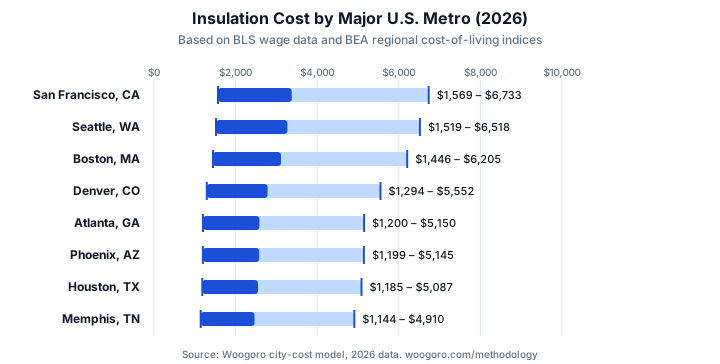
Average Insulation Cost by Material (2026)
Insulation pricing is dominated by the material, with R-value per inch as the second variable. The table below shows installed cost per square foot for the most common residential materials, plus what each is best for.
| Material | Per Square Foot | R-Value per Inch | Best For |
|---|---|---|---|
| Fiberglass batts | $1-$3/sqft | R-3.0 to R-4.0 | Walls, attic floors, DIY-friendly |
| Mineral wool batts | $1.50-$3.50/sqft | R-3.0 to R-4.2 | Fire and sound, basement walls |
| Blown cellulose | $1-$2/sqft | R-3.2 to R-3.7 | Attic top-up, retrofit walls |
| Blown fiberglass | $1-$2.25/sqft | R-2.5 to R-3.5 | Open attic floor, faster install |
| Open-cell spray foam | $1-$2.50/sqft | R-3.5 to R-3.7 | Interior walls, sound dampening, attic underside |
| Closed-cell spray foam | $2-$4.50/sqft | R-6.5 to R-7.0 | Crawl space, rim joist, moisture-prone, conditioned attic |
| Rigid foam board (EPS/XPS/Polyiso) | $1-$3/sqft | R-3.6 to R-6.5 | Basement walls, exterior sheathing, foundation |
| Radiant barrier | $0.30-$1.00/sqft | n/a (radiant) | Hot-climate attic underside, supplement |
| Denim/recycled cotton batts | $1.50-$3.50/sqft | R-3.4 per inch | Eco-friendly, no irritation, sound |
Prices include materials, labor, basic prep, and standard warranty. Air sealing, vapor barriers, vent baffles, and removal of existing insulation are usually quoted separately.
Insulation Cost by Application
The biggest cost driver after material is where the insulation goes. Attics are easiest and cheapest, walls are harder, crawl spaces and rim joists are the hardest. Below are typical project totals by application.
| Application | Typical Total | What's Included |
|---|---|---|
| Attic top-up (1,500 sqft) | $1,500-$3,000 | Blown cellulose to R-49, vent baffles, hatch insulation |
| Attic full retrofit (1,500 sqft) | $2,500-$6,000 | Old insulation removal, air sealing, blown to R-60 |
| Conditioned attic (spray foam) | $4,000-$10,000 | Closed-cell on roof deck, full envelope |
| Wall insulation (retrofit blown) | $2-$4/sqft of wall | Drilled-and-filled exterior walls, patch back |
| Wall insulation (new construction) | $1-$3/sqft of wall | Batts in open studs, no demolition |
| Crawl space encapsulation | $3,000-$8,000 | Vapor barrier, foam-board walls, dehumidifier |
| Rim joist insulation | $500-$2,000 | Closed-cell spray on rim joist perimeter |
| Basement wall insulation | $2,000-$6,000 | Rigid foam or closed-cell on poured walls |
| Garage ceiling insulation | $800-$2,500 | R-30 batts or closed-cell, fire-rated |
| Whole-home retrofit | $8,000-$15,000 | Attic + walls + crawl + air sealing + audit |
Insulation Materials: Fiberglass vs. Cellulose vs. Spray Foam vs. Rigid Foam
Each insulation material has a clear performance profile, cost profile, and use case. The wrong material in the wrong place causes moisture, mold, or fire problems, regardless of how much you spend.
- Fiberglass batts ($1-$3/sqft installed): The default residential material. R-3.0 to R-4.0 per inch. Pre-cut to fit standard stud bays. Easy to install. Loses 30-50% of effective R-value if compressed or installed sloppy. Best for new construction with clean stud cavities. Watch for gaps, voids, and incomplete vapor barrier coverage on retrofit jobs.
- Mineral wool batts ($1.50-$3.50/sqft installed): Higher density than fiberglass. R-3.0 to R-4.2 per inch. Fire-resistant (will not burn until 2,000F+). Excellent sound dampening. Heavier and stiffer to work with than fiberglass. Worth the premium in basement walls, garage ceilings, and shared-wall situations.
- Blown cellulose ($1-$2/sqft installed): Recycled newspaper with borate fire retardant. R-3.2 to R-3.7 per inch settled. Slightly better air-leak resistance than blown fiberglass. Best for attic top-up and retrofit drilled-and-filled wall jobs. Settles 10-20% over time, so installers blow extra to compensate.
- Blown fiberglass ($1-$2.25/sqft installed): Looser-fill than cellulose. R-2.5 to R-3.5 per inch. Faster install, less weight on the ceiling, less dust during application. Slightly worse at blocking air movement than cellulose. Common in production builds and quick attic top-ups.
- Open-cell spray foam ($1-$2.50/sqft installed): Half-pound density. R-3.5 to R-3.7 per inch. Permeable to moisture. Excellent sound dampening. Cannot serve as a vapor barrier. Best for interior walls, attic underside in mixed-humid climates, and noise-control situations. Wrong choice for crawl spaces or anywhere with moisture risk.
- Closed-cell spray foam ($2-$4.50/sqft installed): Two-pound density. R-6.5 to R-7.0 per inch. Acts as a vapor barrier. Stiffens the structure, adds shear strength. Best for crawl spaces, rim joists, foundation walls, and conditioned-attic retrofits. Can off-gas if mixed wrong, so installer training matters more here than on any other material.
- Rigid foam board ($1-$3/sqft installed): EPS, XPS, or polyiso. R-3.6 to R-6.5 per inch. Used as continuous insulation on basement walls, exterior sheathing, and foundation perimeter. Polyiso has the highest R-value and is also the most expensive. Always tape seams and use closed-cell foam at corners for an effective air barrier.
Attic vs. Wall vs. Crawl Space vs. Rim Joist Insulation
Where the insulation goes determines what kind of project this is. Each application has its own labor cost, material best-fit, and code requirements.
- Attic ($1,500-$10,000): Easiest and cheapest insulation upgrade. Blown cellulose to R-49 (warm climate) or R-60 (cold climate). Add vent baffles to maintain soffit-to-ridge airflow. Always seal can lights and other penetrations before adding insulation. Spray-foaming the underside of the roof deck creates a conditioned attic and adds $2,500-$5,000 over blown.
- Walls (drilled-and-filled retrofit, $2-$4/sqft of wall): Existing exterior walls drilled from inside or outside, filled with blown cellulose or fiberglass, holes patched. Less than perfect coverage but a major upgrade for old uninsulated homes. New construction walls take batts at $1-$3/sqft.
- Crawl space ($3,000-$8,000): Encapsulation with vapor barrier, foam-board or closed-cell on the perimeter walls, sealed vents, dehumidifier. Newer code path is conditioned crawl, not vented. Saves 5-15% on heating and cooling, eliminates moisture issues. Worth the cost in any humid climate.
- Rim joist ($500-$2,000): The 1.5-inch band where the floor framing sits on the foundation wall. Massive air-leak source. Closed-cell spray foam is the right call. The single highest-ROI insulation upgrade in many older homes.
- Basement walls ($2,000-$6,000): Rigid foam board or closed-cell spray on the inside of poured concrete or block walls. Code requires a thermal barrier (drywall or thermal-rated panel) over foam. Skip the fiberglass on basement walls; it traps moisture against the concrete.
- Garage ceiling ($800-$2,500): R-30 batts or closed-cell foam. Fire-rated drywall over the insulation if living space is above. Check local fire code carefully.
R-Value Targets by Climate Zone
The DOE recommends specific R-value targets by climate zone. The right target balances energy savings against the cost of additional inches of insulation. Going past R-60 in the attic produces diminishing returns in most homes.
| Climate Zone | Region | Attic R-Value | Wall R-Value | Floor R-Value |
|---|---|---|---|---|
| Zone 1-2 | Southern FL, southern TX, HI | R-30 to R-49 | R-13 to R-15 | R-13 |
| Zone 3 | GA, AL, AZ, southern CA | R-30 to R-60 | R-13 to R-20 | R-19 to R-25 |
| Zone 4 | Mid-Atlantic, OH, southern IL | R-49 to R-60 | R-13 to R-20 | R-19 to R-25 |
| Zone 5 | NY, MA, IL, OR, much of WA | R-49 to R-60 | R-20 to R-21 | R-25 to R-30 |
| Zone 6 | MN, WI, ME, MT, ND | R-49 to R-60 | R-21 to R-25 | R-25 to R-30 |
| Zone 7-8 | AK, far northern MN, MT | R-60 to R-75 | R-25 to R-38 | R-30 to R-38 |
Source: DOE recommended R-values, 2024-2026. Higher targets typically pay back faster in older homes with leaky envelopes. (The federal 25C tax credit, which previously rewarded meeting IECC code R-values, expired Dec 31 2025 — state utility rebates often still require IECC-compliant R-values.)
Federal Tax Credits and Utility Rebates
The federal 25C credit for insulation expired Dec 31 2025, but state utility rebates and IRA HEAR are still active in many states. Stack what you qualify for to cut effective cost 15-50%.
- Federal 25C tax credit — EXPIRED Dec 31 2025: This credit (30%, up to $1,200/year for insulation under the Energy Efficient Home Improvement Credit) was not renewed for 2026. Insulation installed on or after Jan 1 2026 does not qualify. Insulation installed during the 2025 tax year is still claimable on Form 5695 for the 2025 return.
- Federal HOMES rebate program: Performance-based rebates of $2,000 to $4,000 (or higher for low-income) for whole-home retrofits that hit measured energy savings. State-administered, rolling out through 2027.
- Federal HEAR program: Income-qualified high-efficiency electrification rebates that can stack with insulation in some configurations.
- Utility rebates ($0.10-$0.50/sqft): Attic insulation rebates from electric and gas utilities. Typically require a pre-audit and post-audit by the utility.
- State energy office programs: NY, MA, CA, OR, WA, MN, and others run additional incentive programs. Check your state energy office website.
- Documentation: Keep manufacturer R-value certifications, contractor invoices, and photos of installed depth markers in attic. The IRS requires documentation if claimed and audited.
What Should an Insulation Quote Include?
Itemized quotes are the only way to compare contractors fairly. Round-number quotes hide the same scope omissions over and over. A complete insulation quote should list every line below.
- Square footage of each application area (attic, walls, crawl, rim joist, etc.)
- Target R-value (must meet or exceed IECC code for your climate zone)
- Material type and manufacturer (Owens Corning, CertainTeed, Knauf, Icynene, etc.)
- Installed depth (for blown) or thickness (for spray foam)
- Air sealing scope (caulking, foam, weatherstripping at penetrations)
- Vapor barrier material and orientation (climate-zone specific)
- Vent baffles in attic (one per rafter bay, soffit-to-ridge)
- IC-rated covers over recessed lights (or replacement of non-IC fixtures)
- Removal of old or wet insulation (separately priced if applicable)
- Mold or asbestos testing (especially for old vermiculite)
- Permit pulled by contractor (if required by local code)
- Drywall patching after retrofit blown wall installation
- Energy audit pre and post (often required for utility rebate)
- R-value certification document for tax credit
- Workmanship warranty (1-2 years standard, 5-10 years on spray foam)
- Manufacturer warranty (lifetime on most fiberglass and cellulose, 25+ on closed-cell foam)
- License number on the quote (verify it is active before signing)
- Insurance certificate (general liability + workers comp)
Hidden Insulation Costs Most Homeowners Miss
Insulation jobs blow budget more than most homeowners expect because the visible price covers the material but not the supporting work. Watch for these.
- Air sealing prep ($300-$1,500): Caulking, spray foam at top plates, weatherstripping at attic hatch and recessed lights. Always required before insulation. Often left off cheap quotes.
- Vent baffles in attic ($150-$500): One per rafter bay to maintain soffit-to-ridge airflow. Required by code in most jurisdictions. Skipping baffles when blowing over the soffit causes ice dams and moisture damage.
- IC-rated covers over recessed lights ($30-$80 each): Required to prevent overheating where blown insulation contacts non-IC light fixtures. Old non-IC fixtures should be replaced rather than covered.
- Mold remediation if existing insulation is wet ($500-$5,000): Wet insulation in attics or crawl spaces almost always means mold. Remediation is a separate job and trade.
- Asbestos testing on old vermiculite ($300-$800): Vermiculite from 1920s-1990s often contains asbestos. Test before disturbing. Removal of asbestos-contaminated vermiculite is $5-$15 per square foot and requires licensed abatement.
- Drywall patching after retrofit blown wall insulation ($300-$1,500): Drilled-and-filled wall jobs require small holes per stud bay, patched and painted afterward.
- Energy audit pre/post ($200-$500 each): Required by some utility rebate programs. Pre-audit identifies air leaks; post-audit verifies improvement.
- Old insulation removal ($1-$2/sqft): Required when adding spray foam over existing batts or when existing insulation is contaminated.
- Crawl space dehumidifier ($800-$2,000): Required after encapsulation to maintain humidity below 60% RH. Skipping it can cause mold within months.
- Vapor barrier on the wrong side: Climate-zone specific. In cold climates, vapor barrier goes on the warm-in-winter side (interior). In hot-humid climates, often no interior vapor barrier (or a smart membrane). Wrong-side vapor barrier traps moisture and rots the wall.
Insulation Cost by City
Insulation labor rates vary by metro because installation work scales with local construction wages, and material delivery distance varies by metro. Below are 30 U.S. cities with their typical mid-job range (the $2,500-$6,000 national-median band, which covers a typical attic retrofit), plus the variance vs. the U.S. median. Click any city for full local pricing.
| City | Attic Retrofit (1,500 sqft) | vs. National Median |
|---|---|---|
| Atlanta, GA | $2,425-$5,820 | ~3% lower |
| Austin, TX | $2,500-$6,000 | at median |
| Baltimore, MD | $2,625-$6,300 | ~5% higher |
| Boston, MA | $3,050-$7,320 | ~22% higher |
| Charlotte, NC | $2,375-$5,700 | ~5% lower |
| Chicago, IL | $2,625-$6,300 | ~5% higher |
| Columbus, OH | $2,325-$5,580 | ~7% lower |
| Dallas, TX | $2,425-$5,820 | ~3% lower |
| Denver, CO | $2,625-$6,300 | ~5% higher |
| Detroit, MI | $2,375-$5,700 | ~5% lower |
| Houston, TX | $2,425-$5,820 | ~3% lower |
| Indianapolis, IN | $2,325-$5,580 | ~7% lower |
| Jacksonville, FL | $2,375-$5,700 | ~5% lower |
| Kansas City, MO | $2,325-$5,580 | ~7% lower |
| Las Vegas, NV | $2,550-$6,120 | ~2% higher |
| Los Angeles, CA | $3,050-$7,320 | ~22% higher |
| Memphis, TN | $2,200-$5,280 | ~12% lower |
| Miami, FL | $2,500-$6,000 | at median |
| Milwaukee, WI | $2,425-$5,820 | ~3% lower |
| Minneapolis, MN | $2,575-$6,180 | ~3% higher |
| Nashville, TN | $2,375-$5,700 | ~5% lower |
| New York, NY | $3,250-$7,800 | ~30% higher |
| Philadelphia, PA | $2,625-$6,300 | ~5% higher |
| Phoenix, AZ | $2,450-$5,880 | ~2% lower |
| Portland, OR | $2,625-$6,300 | ~5% higher |
| Raleigh, NC | $2,375-$5,700 | ~5% lower |
| San Antonio, TX | $2,375-$5,700 | ~5% lower |
| San Diego, CA | $2,950-$7,080 | ~18% higher |
| San Francisco, CA | $3,300-$7,920 | ~32% higher |
| Seattle, WA | $2,800-$6,720 | ~12% higher |
See insulation pricing in 1,000+ U.S. cities → or browse the full insulation cost guide for material deep-dives.
How to Get the Best Insulation Quote
- Get an energy audit or know your climate zone. DOE recommends R-30 to R-60 attic depending on zone. An audit ($200-$500) identifies air leaks first, where the biggest gains usually are.
- Get 2-3 written quotes from licensed insulation contractors. Single-quote homeowners pay 15-30% above market.
- Verify R-value, material, and square footage match. All three quotes must specify the same target R-value, the same material, and the same area. Cheaper quotes often quietly drop R-value or skip air sealing.
- Confirm air sealing is included. Air sealing always comes before insulation. Skipping it is the most common shortcut and biggest performance killer.
- Verify vapor barrier orientation. Climate-zone specific. Wrong-side vapor barrier rots walls. Confirm in writing.
- Check tax credit and rebate documentation. Confirm the contractor provides IRS-compliant docs for the 30% federal credit (up to $1,200/year for insulation) and any utility rebates.
- Verify license and insurance. Active license number on the quote, current GL and workers comp certificate. Spray foam crews especially need proper licensing.
- Pay schedule sanity-check. 25-50% deposit is normal. Final payment after install is verified to spec. Anything over 50% up front is a red flag.
Insulation Quote Red Flags
- Under-insulating to your climate zone. Hitting R-30 in a climate that calls for R-60 is the most common shortcut. Verify the quote meets the IECC code for your zone.
- Vapor barrier on the wrong side. Climate-zone specific. Cold climates: vapor barrier on warm-in-winter side. Hot-humid climates: often no interior vapor barrier or a smart membrane. Wrong-side vapor barrier rots the wall.
- Spray foam in the attic without vent baffles. If foaming the underside of the roof deck, the attic becomes conditioned and you need a sealed envelope. If foaming the attic floor over a vented attic, you still need soffit-to-ridge airflow.
- Blown insulation over recessed lights without IC-rated covers. Fire risk on non-IC fixtures. Should be replaced or covered before blowing.
- Ignoring air sealing first. A leaky envelope wastes 30-50% of insulation R-value. Air seal first, insulate second.
- Skipping vent baffles. Soffit-to-ridge airflow is required by code. Skipping baffles when blowing over soffits causes ice dams and moisture damage.
- Unmarked old insulation removal. Vermiculite from 1920s-1990s often contains asbestos. Demand testing before removal of any old loose-fill that might be vermiculite.
- Spray foam without proper licensing. Spray foam requires installer training and certification. Improper mix off-gasses formaldehyde-related chemicals. Demand the licensed installer's name and certification number.
- Cash-only or below-market quote. Insulation is heavily incentivized; legitimate contractors are happy to be paperwork-compliant.
- Same-day pressure to sign. Legitimate contractors hold pricing 30 days. High-pressure tactics correlate with overpriced jobs.
Insulation Permits and Code Notes
Most U.S. cities do not require a permit for simple attic top-ups but do require permits for spray foam in occupied areas, conditioned-attic conversions, crawl space encapsulation, and any work that changes the building envelope. Permit fees usually run $50 to $300, processed in 1 to 3 weeks. The contractor should pull the permit. If they ask you to pull it, that is a licensing red flag.
Beyond the permit, three code areas commonly trip up homeowners:
- Vapor barrier orientation by climate zone. IRC Chapter 7 specifies vapor retarder requirements by climate zone. Cold climate (zones 5-8): Class I or II vapor retarder on the interior side. Mixed-humid (zone 4): often a smart membrane or no interior retarder. Hot-humid (zones 1-3): no interior retarder. Wrong-side vapor barrier is the single most common moisture-damage cause.
- Thermal barrier over foam. IRC requires drywall (15-minute thermal barrier) or thermal-rated panel over exposed foam in living spaces and basements. Skipping this fails inspection and creates fire risk.
- Soffit-to-ridge ventilation. Required in vented attics. Vent baffles must be installed at every rafter bay before blowing or batting.
If you are buying a home with a documented spray foam or conditioned-attic install, request the permit number, final inspection sign-off, and the manufacturer's R-value and product certification. Without those, the work is essentially undisclosed on resale.
How Much Can You Save on Insulation?
Realistic savings levers, ranked by effort vs. payoff:
- Stack federal + utility incentives (saves 30-60%). 30% federal credit (up to $1,200/year for insulation), $0.10-$0.50/sqft utility rebates, state energy office programs. Highest-ROI move.
- Get 2-3 quotes (saves 15-30%). Single-quote homeowners pay 15-30% above market for insulation.
- Air seal first, insulate second (improves payback 2-4x). A leaky envelope wastes most of the new insulation's R-value. Air sealing alone often pays back in 2-4 years.
- Top up instead of replacing (saves 60-80%). If existing attic insulation is dry and uncontaminated, blowing more on top to hit the target R-value is dramatically cheaper than removal and replacement.
- DIY batts and rigid foam (saves 50-70% on labor). Fiberglass batts and rigid foam board are DIY-friendly. Always wear N95, eye protection, and full-coverage clothing.
- Phase whole-home over 2-3 tax years (claim more than $1,200 cap). Annual cap renews each tax year. Doing attic in year 1 and walls in year 2 can claim $2,400 instead of $1,200.
- Schedule outside peak HVAC season (saves 5-15%). Late spring or early fall, when contractors have open schedules.
- Bundle with HVAC or window upgrades (saves 5-10%). Same crew on site for multiple energy upgrades is often cheaper than separate jobs.
Insulation FAQ
How much does insulation cost in 2026?
Insulation costs $1 to $7 per square foot installed in 2026 depending on type. Fiberglass batts run $1 to $3 per square foot. Blown cellulose runs $1 to $2 per square foot. Open-cell spray foam runs $1 to $2.50 per square foot. Closed-cell spray foam runs $2 to $4.50 per square foot. Rigid foam board runs $1 to $3 per square foot. Whole-home insulation projects typically cost $2,000 to $15,000 depending on home size and scope.
How much does spray foam insulation cost?
Open-cell spray foam costs $1 to $2.50 per square foot installed in 2026. Closed-cell spray foam costs $2 to $4.50 per square foot. A typical 1,500 square foot attic runs $1,500 to $3,750 in open-cell or $3,000 to $6,750 in closed-cell. Closed-cell has the highest R-value per inch (about R-7) and acts as a vapor barrier. Open-cell is cheaper, less dense (about R-3.7 per inch), and is fine for interior applications.
How much does blown insulation cost?
Blown cellulose insulation costs $1 to $2 per square foot installed in 2026. Blown fiberglass runs $1 to $2.25 per square foot. A typical 1,500 square foot attic runs $1,500 to $3,000. Cellulose is denser, made from recycled paper with borate fire retardant, and has slightly better air-leak resistance than blown fiberglass. Blown insulation is the most cost-effective way to top up an under-insulated attic to current R-value targets.
How much does attic insulation cost?
Attic insulation costs $1,500 to $5,500 for a typical 1,500 square foot attic in 2026. Topping up existing insulation with blown cellulose runs $1,500 to $3,000. Removing old insulation and re-blowing runs $2,500 to $5,000. Spray-foaming the underside of the roof deck (creating a conditioned attic) runs $4,000 to $10,000. Adding R-49 to a previously uninsulated attic typically pays back in 4 to 7 years through energy savings.
How much insulation do I need in my attic?
The DOE recommends R-30 to R-49 for attics in warm climates (zones 1-3, southern U.S.) and R-49 to R-60 for attics in cold climates (zones 4-7, northern U.S.). That equals 9 to 22 inches of fiberglass batts, 8 to 18 inches of blown cellulose, or 5 to 9 inches of closed-cell spray foam. A professional energy audit ($200 to $500) determines the exact target for your home and climate zone.
Are there tax credits for insulation in 2026?
No federal credit applies to insulation installed on or after Jan 1 2026. The Section 25C Energy Efficient Home Improvement Credit (which previously covered 30 percent of insulation materials up to $1,200 per year) expired Dec 31 2025. State utilities and energy offices still offer rebates of $200–$1,700, and the IRA HEAR program (income-qualified) is still rolling out through state agencies. Check dsireusa.org for what is active where you live.
Can I install insulation myself?
Fiberglass batts and rigid foam board are DIY-friendly and save 50 to 70 percent on labor. Blown cellulose can be DIY with a rented blower for around $300 to $500 in materials per typical attic. Spray foam should always be hired out. Improper application creates moisture problems, off-gassing risks, and can void manufacturer warranties. Always wear an N95 respirator, eye protection, and full-coverage clothing for any insulation work. Old vermiculite should be tested for asbestos before disturbing.
How much can insulation save on energy bills?
Properly insulating an under-insulated home typically reduces heating and cooling costs 15 to 30 percent. For a typical $2,000 per year home energy bill, that is $300 to $600 annually. Payback periods on attic insulation are usually 3 to 7 years. Payback on whole-home retrofits can be 7 to 15 years. Air sealing combined with insulation pays back faster than insulation alone, sometimes in 2 to 4 years.
See if your insulation quote is fair
Upload your contractor quote and we'll compare it against city wage data, flag missing scope, and tell you the realistic price range for your exact project. Free, no email required.
How We Calculate Insulation Costs
Every per-square-foot and per-city range on this page is built from three public datasets: Bureau of Labor Statistics Occupational Employment and Wage Statistics for insulation workers (floor, ceiling, and wall), Bureau of Economic Analysis Regional Price Parities for material adjustments, and 2026 retail material pricing from major U.S. insulation distributors and manufacturers (Owens Corning, CertainTeed, Knauf, Icynene, BASF). Ranges represent the middle 60-70% of typical residential quotes, not the extremes. Read our full methodology for details on how city multipliers are derived.