

Got a concrete quote?
Upload it and we'll check the price against city wage data and flag missing scope items like base prep depth, rebar, control joints, or sealer. Free, no email.
Average Concrete Cost by Application (2026)
Concrete pricing depends on the application. Driveways, patios, sidewalks, and foundation slabs each have different thickness and reinforcement requirements that drive cost. The table below shows installed cost per square foot by application, plus the typical project total.
| Application | Per Square Foot | Typical Project Total | Standard Spec |
|---|---|---|---|
| Driveway (plain broom) | $8-$15/sqft | $4,800-$9,000 (600 sqft) | 4" thick, mesh or fiber, 3,500 PSI |
| Driveway (heavy vehicle) | $10-$18/sqft | $6,000-$10,800 (600 sqft) | 5-6" thick, rebar grid, 4,000 PSI |
| Patio (plain broom) | $8-$16/sqft | $2,400-$4,800 (300 sqft) | 4" thick, mesh or fiber |
| Sidewalk | $6-$14/sqft | $600-$1,400 (100 sqft, 4ft wide) | 4" thick, mesh, control joints |
| Pool deck | $8-$18/sqft | $5,600-$12,600 (700 sqft) | 4" thick, broom or stamped, sealed |
| Garage slab (new construction) | $5-$10/sqft | $2,400-$4,800 (480 sqft) | 4-6" thick, vapor barrier, rebar |
| Foundation slab (residential) | $6-$15/sqft | $12,000-$30,000 (2,000 sqft) | 4" thick, vapor barrier, rebar grid |
| Footing/foundation wall | $8-$25/LF | $1,600-$5,000 (200 LF) | By engineer spec, frost depth |
| Concrete steps | $300-$600 per step | $1,500-$3,000 (5 steps) | Reinforced, formed, finished |
| Asphalt driveway (comparison) | $5-$10/sqft | $3,000-$6,000 (600 sqft) | 2-3" hot-mix on compacted base |
Prices include form work, ready-mix delivery, pour, finishing, and standard control joints. Removal of existing concrete adds $2-$5/sqft. Base prep beyond standard 4-inch gravel adds $1-$3/sqft.
Concrete Cost by Finish
The finish is the single biggest pricing lever on a concrete quote. The same slab can swing from $4 to $25 per square foot depending on what the surface looks like when it cures.
| Finish | Per Square Foot | Best For |
|---|---|---|
| Plain broom finish | $4-$8/sqft | Driveways, garage slabs, utility |
| Acid stain (on existing slab) | $4-$7/sqft | Cheapest decorative upgrade |
| Concrete dye (on existing slab) | $3-$6/sqft | Solid color, interior or exterior |
| Scored / sawcut pattern | $5-$10/sqft | Tile-look, modern simplicity |
| Salt finish (textured) | $5-$8/sqft | Pool decks, slip resistance |
| Exposed aggregate | $6-$12/sqft | Driveways, patios, durability |
| Stained concrete (poured + stained) | $7-$13/sqft | Patios, pool decks, decorative |
| Stamped concrete | $8-$18/sqft | Patios, walkways, paver-look |
| Polished concrete (interior) | $3-$8/sqft (over existing) | Garages, basements, modern interior |
| Decorative overlay | $8-$20/sqft | Resurfacing existing slabs |
| Premium decorative slab | $10-$25+/sqft | Multi-color, multi-pattern, custom |
Deep-dive on stamped, exposed aggregate, stained, and polished pricing in our concrete finishes comparison guide.
Concrete Thickness, PSI, and Reinforcement
The three specs that separate a 30-year slab from a 5-year slab are thickness, PSI rating, and reinforcement. Cheap quotes cut all three.
- Thickness: 4 inches is the residential code minimum for driveways, patios, sidewalks, and garage slabs. 5-6 inches for heavy vehicles (RV pads, work trucks, equipment). Anything under 4 inches is a code violation and the single biggest red flag in a low-ball quote.
- PSI rating: 3,000 PSI is the residential minimum. 4,000 PSI is the right call for driveways, garage slabs, and any freeze-thaw region. 4,500-5,000 PSI for heavy commercial loads. The cost difference between 3,000 and 4,000 PSI is $5-$15 per cubic yard, well worth it for a 30-year asset.
- Reinforcement (mesh): Welded wire mesh ($0.50-$1.00/sqft) is the budget option. Holds together hairline cracks but provides minimal load support. Adequate for sidewalks and small patios.
- Reinforcement (rebar): #3 or #4 rebar in a 12 to 18 inch grid ($1.50-$3.00/sqft) is the durability default for driveways and garage slabs. Required for vehicles over 6,000 lb.
- Reinforcement (fiber): Synthetic fibers mixed into the ready-mix ($5-$15 per cubic yard add-on). Reduces shrinkage cracking. Often used together with mesh or rebar, not as a substitute.
- Vapor barrier (under living spaces): 6-mil or 10-mil polyethylene under any slab inside conditioned space. Blocks ground moisture. Skipping this on a basement or addition slab is a long-term mold risk.
- Thickened edges: 6 inches at the perimeter prevents edge cracking on driveways and patios. Standard on quality work, often skipped on low-ball quotes.
Concrete Finishes: Plain vs. Stamped vs. Exposed Aggregate vs. Stained
Beyond the application, the finish drives 50 to 200 percent of the price difference. Each finish has clear strengths and trade-offs.
- Plain broom finish ($4-$8/sqft): Brushed-in surface texture for traction. Default for driveways, garage slabs, utility patios. Most durable. Easiest to repair. Sealed annually for best wear.
- Stamped concrete ($8-$18/sqft): Texture mats pressed into wet concrete create a slate, brick, cobblestone, or wood-plank look. Color hardener and antiquing release agent add depth. Beautiful for patios and walkways. Vulnerable to freeze-thaw cracking and color fade. Re-seal every 2-3 years to maintain.
- Exposed aggregate ($6-$12/sqft): Surface paste washed off to expose decorative aggregate (river rock, pea gravel, granite). Excellent slip resistance, very durable, ages well. Harder to keep clean than smooth finishes. The classic 1970s-1990s premium driveway look.
- Stained concrete ($7-$13/sqft poured + stained, or $4-$7/sqft on existing): Acid stain or water-based stain penetrates the surface. Permanent color. Variegated, marble-like. Requires sealing. The cheapest way to upgrade an unattractive existing slab.
- Polished concrete ($3-$8/sqft over existing slab): Diamond grinding plus densifier creates a glossy finish. Common in garages, basements, modern interiors. Will not work on slabs that are too soft or too damaged.
- Decorative overlay ($8-$20/sqft): Polymer-modified topping over an existing slab. Fixes ugly slabs without removal. Multiple finish options. 8-15 year lifespan if sealed properly.
Rule of thumb: plain broom for utility and budget, exposed aggregate for durability + decoration, stamped for the best aesthetic-to-cost ratio on patios, stained for the cheapest decorative upgrade on existing slabs.
What Should a Concrete Quote Include?
Itemized quotes are the only way to compare contractors fairly. Round-number quotes hide the same scope omissions over and over. A complete concrete quote should list every line below.
- Total square footage and project dimensions
- Slab thickness (4 inches minimum, 5-6 inches for heavy loads)
- PSI rating of the ready-mix (3,000 minimum, 4,000 preferred)
- Reinforcement (mesh, #3 or #4 rebar, fiber, or combination)
- Base prep depth and material (4 inches compacted gravel standard)
- Vapor barrier (under living spaces or interior slabs)
- Form work and form removal
- Ready-mix delivery (cubic yards, mix design)
- Finish type (broom, stamped, exposed aggregate, stained, etc.)
- Color and pattern detail (for decorative finishes)
- Control joints (cut at 2x slab thickness in feet, max 12 feet apart for 4-inch slab)
- Expansion joints at structures and turns
- Curing method (compound, plastic sheet, blankets) and schedule
- Sealer (type, application schedule, separately priced)
- Removal of existing concrete (separately priced if applicable)
- Permit pulled by contractor
- Cleanup and haul-away of debris
- Workmanship warranty (1-2 years standard)
- License number on the quote
- Insurance certificate (general liability + workers comp)
Hidden Concrete Costs Most Homeowners Miss
Concrete jobs blow budget more than most home improvements because the visible price covers the pour but not the supporting work. Watch for these.
- Removal of existing concrete ($2-$5/sqft): Often quoted separately or assumed as homeowner-provided. Saw-cutting and breaking a 4-inch slab takes a full day for a typical driveway.
- Grading and base prep beyond standard ($1-$3/sqft): If the existing soil is poor, the contractor needs to dig deeper and import more gravel. Make sure the quote specifies the base prep depth.
- Vapor barrier under living spaces ($0.20-$0.50/sqft): Required under any slab inside conditioned space. Often skipped on cheap quotes.
- Sealer ($0.25-$0.75/sqft): Almost always quoted separately. A penetrating sealer is essential for stamped, stained, and exposed aggregate. Plain broom is OK without sealer for the first year but should be sealed by year 2.
- Control joints (cut after pour): Should be saw-cut within 24 hours of finishing, at a depth of 1/4 the slab thickness, no farther apart than 2-3x the slab thickness in feet. A 4-inch slab needs joints every 8-12 feet. Quotes that omit control-joint specs often leave the slab at risk of random cracking.
- Permit fees ($25-$300): Often left off the base quote. Some contractors ask the homeowner to pull the permit, which is a licensing red flag.
- Apron and curb cut ($300-$1,500): Driveway aprons (the transition from street to driveway) often require city permit and a separate concrete cut. Not always in the base quote.
- Drainage and grading correction: Sloping the slab away from the house, adding French drain, or cutting in catch basins. Critical to prevent foundation moisture, often overlooked.
- Tear-out and replacement of fence, landscaping, sprinklers ($300-$2,000): Often disrupted by the truck and pump access. Restoration usually NOT included.
- Concrete pump fee ($600-$1,500): Required when truck access is blocked. Adds significantly to small or hard-to-reach pours.
- Cold-weather or hot-weather premium ($50-$300 per pour): Heated water, blankets, or curing compound for extreme weather. May be a separate line item.
Concrete Cost by City
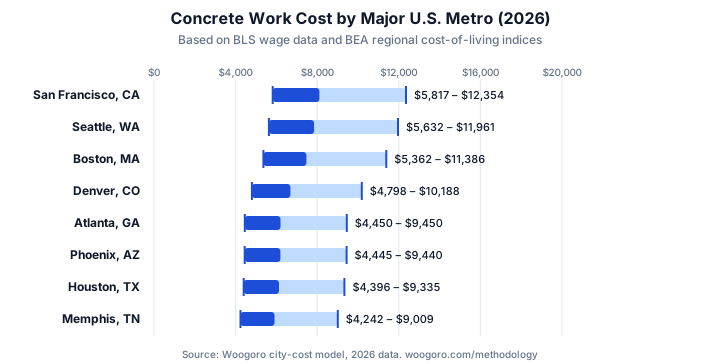
Concrete labor rates vary by metro because cement masons and finishers scale with local construction wages, and ready-mix delivery distances vary by metro size. Below are 30 U.S. cities with their typical mid-job range (the $4,500-$9,500 national-median band, which covers a 600-sqft 2-car driveway), plus the variance vs. the U.S. median. Click any city for full local pricing.
| City | Driveway (600 sqft) | vs. National Median |
|---|---|---|
| Atlanta, GA | $4,365-$9,215 | ~3% lower |
| Austin, TX | $4,500-$9,500 | at median |
| Baltimore, MD | $4,725-$9,975 | ~5% higher |
| Boston, MA | $5,490-$11,590 | ~22% higher |
| Charlotte, NC | $4,275-$9,025 | ~5% lower |
| Chicago, IL | $4,725-$9,975 | ~5% higher |
| Columbus, OH | $4,185-$8,835 | ~7% lower |
| Dallas, TX | $4,365-$9,215 | ~3% lower |
| Denver, CO | $4,725-$9,975 | ~5% higher |
| Detroit, MI | $4,275-$9,025 | ~5% lower |
| Houston, TX | $4,365-$9,215 | ~3% lower |
| Indianapolis, IN | $4,185-$8,835 | ~7% lower |
| Jacksonville, FL | $4,275-$9,025 | ~5% lower |
| Kansas City, MO | $4,185-$8,835 | ~7% lower |
| Las Vegas, NV | $4,590-$9,690 | ~2% higher |
| Los Angeles, CA | $5,490-$11,590 | ~22% higher |
| Memphis, TN | $3,960-$8,360 | ~12% lower |
| Miami, FL | $4,500-$9,500 | at median |
| Milwaukee, WI | $4,365-$9,215 | ~3% lower |
| Minneapolis, MN | $4,635-$9,785 | ~3% higher |
| Nashville, TN | $4,275-$9,025 | ~5% lower |
| New York, NY | $5,850-$12,350 | ~30% higher |
| Philadelphia, PA | $4,725-$9,975 | ~5% higher |
| Phoenix, AZ | $4,410-$9,310 | ~2% lower |
| Portland, OR | $4,725-$9,975 | ~5% higher |
| Raleigh, NC | $4,275-$9,025 | ~5% lower |
| San Antonio, TX | $4,275-$9,025 | ~5% lower |
| San Diego, CA | $5,310-$11,210 | ~18% higher |
| San Francisco, CA | $5,940-$12,540 | ~32% higher |
| Seattle, WA | $5,040-$10,640 | ~12% higher |
See concrete pricing in 1,000+ U.S. cities → or browse the full concrete cost guide for material deep-dives.
How to Get the Best Concrete Quote
- Measure the area and decide the finish first. Length x width = square footage. Decide finish (broom, stamped, exposed aggregate, stained) before quoting. Finish swings price 50-200%.
- Get 3 written quotes from licensed concrete contractors. Single-quote homeowners pay 15-30% above market on concrete.
- Verify thickness and reinforcement match. All three quotes must specify 4-inch minimum, the same PSI mix, and the same reinforcement (mesh, rebar, or fiber). Cheaper quotes often quietly drop reinforcement or pour 3 inches.
- Confirm permit and inspection responsibility. Contractor pulls the permit on driveways, large patios, and any slab adding to the home footprint. If they ask you to pull it, that is a licensing red flag.
- Check the warranty in writing. 1-2 year workmanship warranty standard. Cracking under warranty should trigger sealing or repair.
- Verify license and insurance. Active license number on the quote, current GL and workers comp certificate. Call the state board to confirm.
- Pay schedule sanity-check. 25-50% deposit is normal. Final payment after the slab cures and you have inspected for cracks. Anything over 50% up front is a red flag.
- Schedule for stable weather. Avoid pours in temperatures under 40F or over 90F unless the contractor guarantees curing protection.
Concrete Quote Red Flags
- 3-inch pour. Code requires 4-inch minimum for driveways and patios. A 3-inch slab will crack within 5 years and can be required to be torn out by city inspectors.
- No rebar or mesh on driveways. Plain concrete slabs without reinforcement crack at random and shift over time. Always demand mesh, rebar, or fiber on a driveway.
- No expansion joints or control joints in spec. Control joints prevent random cracking. A 4-inch slab needs a joint every 8-12 feet, cut within 24 hours of pour. Skipping this guarantees cracking.
- No curing compound or curing plan. Concrete that dries too fast cracks at the surface. A curing plan (compound, blankets, plastic) is essential.
- Weekend cash-only no permit. Skipping permits on driveways usually means city tear-out orders and voided homeowners insurance after a problem.
- Same-day pressure to sign. Legitimate contractors hold pricing 30 days. High-pressure tactics correlate with overpriced jobs.
- Below-market quote (30%+ under others). Usually missing thickness, reinforcement, base prep, or proper licensing.
- No license number on the quote. A legitimate contractor lists their state license on every estimate.
- Vague mix spec. "Standard concrete" with no PSI listed is a tell. Demand 3,000 PSI minimum on the quote.
- Knock-on-door storm chasers. After a hailstorm or freeze, watch for traveling crews offering "we have leftover concrete from a job nearby." This is almost always a scam.
Concrete Permits and HOA Notes
Most U.S. cities require a permit for concrete slabs over a certain size threshold (often 30 to 100 square feet) or any pour that adds to the home footprint or affects drainage. Driveways and large patios almost always require permits. Permit fees usually run $25 to $300, processed in 1 to 3 weeks. The contractor should pull the permit. If they ask you to pull it, that is a licensing red flag.
Beyond the permit, three things commonly trip up homeowners on concrete projects:
- Driveway aprons and curb cuts. The transition from the public street to your driveway is regulated separately by most municipalities. Permit fees and inspection are separate from the main pour, often $200-$1,500.
- Drainage and easements. A new patio or driveway that changes drainage onto a neighbor's property can trigger a violation. Confirm grading and runoff plan in writing.
- HOA rules. Material, color, finish, and even the size of decorative concrete are commonly regulated. Some HOAs ban stamped or colored concrete entirely. Check before signing.
If you are buying a home with a recent driveway or patio replacement, request the permit number and final inspection sign-off. Without those, the work is essentially undisclosed on resale.
How Much Can You Save on Concrete?
Realistic savings levers, ranked by effort vs. payoff:
- Get 3 quotes (saves 15-30%). Single-quote homeowners pay roughly 15-30% above market for concrete. Highest-ROI move.
- Pick a simpler finish (saves 30-60%). Plain broom is half the cost of stamped. Exposed aggregate is 70-80% of stamped pricing. Choose the finish that matches the use, not what looks good in the brochure.
- DIY removal of old concrete (saves $2-$5/sqft). Saw-cutting and breaking is straightforward with a rented breaker. Disposal is the harder part; some contractors will haul if you do the breaking.
- Bundle multiple pours (saves 5-15%). Driveway + walkway + small patio in the same pour is cheaper per square foot than three separate jobs.
- Off-season install (saves 5-15%). Late fall in temperate climates, or any weekday in shoulder season. Avoid peak summer when crews are booked.
- DIY sealer (saves $0.25-$0.75/sqft). Penetrating sealer is roller-applied, no special equipment. One weekend, $100-$300 in supplies.
- Stain or polish existing slab instead of replacing (saves 60-80%). If the slab is structurally sound but ugly, staining or polishing is dramatically cheaper than tear-out and replace.
- Avoid pump-truck access requirements. If you can give the truck a clear path, you save the $600-$1,500 pump fee.
Concrete FAQ
How much does concrete cost per square foot in 2026?
Concrete costs $4 to $15 per square foot installed in 2026. Plain broom-finished concrete runs $4 to $8 per square foot. Stamped concrete runs $8 to $18 per square foot. Exposed aggregate runs $6 to $12 per square foot. Stained or scored finishes run $4 to $10 per square foot. Decorative slabs with multiple finishes can hit $10 to $25 or more per square foot. Pricing includes form work, base prep, ready-mix delivery, pour, finishing, and standard control joints.
How much does a concrete driveway cost?
A standard concrete driveway costs $4,500 to $9,500 in 2026, or $8 to $15 per square foot installed. A typical 2-car driveway (~600 square feet) runs $4,800 to $9,000. Stamped concrete adds 50 percent to the base cost. Exposed aggregate adds 20 to 30 percent. Local labor rates and ready-mix concrete prices are the two biggest variables. Removal of an existing driveway adds $2 to $5 per square foot.
What is the cheapest type of concrete?
Plain broom-finished concrete is the cheapest at $4 to $8 per square foot installed. Acid stain or basic concrete dye on existing slabs runs $4 to $7 per square foot, the lowest-cost way to upgrade an unattractive slab. Asphalt is cheaper still ($5 to $10 per square foot) but is not technically concrete. Among decorative options, stained concrete and basic patterned scoring are the cheapest upgrades over plain broom.
How thick should a concrete driveway be?
Residential driveways should be 4 inches thick for cars and 5 to 6 inches for heavy vehicles like RVs or work trucks. Patios and walkways are typically 4 inches. A 4-inch compacted gravel base underneath is standard. Thickened edges (6 inches at the perimeter) prevent edge cracking. Anything thinner than 4 inches violates most residential code and is the single biggest red flag in a low-ball quote.
How long does concrete take to cure?
Concrete reaches roughly 70 percent of design strength in 7 days, 90 percent in 14 days, and full cure in 28 days. You can walk on it after 24 to 48 hours. Drive on it after 7 days. Avoid heavy vehicles for 14 days. Sealers should be applied 28 days after the pour, never sooner. Cold-weather pours cure more slowly and may need blankets. Hot-weather pours need misting or a curing compound to prevent surface cracking.
Is stamped concrete cheaper than pavers?
Yes. Stamped concrete costs $8 to $18 per square foot installed. Concrete pavers cost $13 to $25 per square foot installed. Natural stone pavers cost $20 to $40 per square foot. Pavers handle settling and frost heave better than stamped concrete and are easier to repair, but the upfront cost is 30 to 50 percent higher. Stamped concrete is the better choice when budget matters and the substrate is stable. Pavers are the better choice for unstable soil or freeze-thaw climates.
Do I need a permit to pour concrete?
Most cities require a permit for concrete slabs over a certain size threshold (often 30 to 100 square feet) or any pour that adds to the home footprint or affects drainage. Driveways and large patios almost always require permits. Small repair patches usually do not. Permit fees run $25 to $300 depending on the city. The contractor should pull the permit. If they ask you to pull it, that is a licensing red flag.
How much is concrete per cubic yard in 2026?
Ready-mix concrete delivered to a residential job site costs $140 to $200 per cubic yard in 2026, with a typical $100 to $150 short-load fee for orders under 10 cubic yards. A standard 4-inch-thick 600 square foot driveway uses about 7.5 cubic yards. Stronger mixes (4,000 PSI vs 3,000 PSI) add $5 to $15 per cubic yard. Fiber-reinforced mixes add another $5 to $10 per cubic yard.
See if your concrete quote is fair
Upload your contractor quote and we'll compare it against city wage data, flag missing scope, and tell you the realistic price range for your exact project. Free, no email required.
How We Calculate Concrete Costs
Every per-square-foot and per-city range on this page is built from three public datasets: Bureau of Labor Statistics Occupational Employment and Wage Statistics for cement masons and concrete finishers, Bureau of Economic Analysis Regional Price Parities for material adjustments, and 2026 retail material pricing from major U.S. ready-mix suppliers and concrete-supply distributors. Ranges represent the middle 60-70% of typical residential quotes, not the extremes. Read our full methodology for details on how city multipliers are derived.