

Got an electrical quote?
Upload it and we'll check the price against city wage data and flag missing scope items like permits, AFCI/GFCI upgrades, or drywall patching. Free, no email.
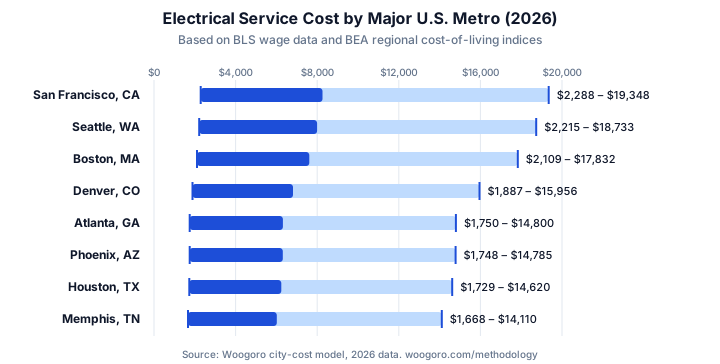
Average Electrical Cost by Project (2026)
Electrical pricing is dominated by the project type, not the home's square footage. The table below shows installed cost by job, plus when each upgrade is typically needed.
| Service | Typical Range | When Needed |
|---|---|---|
| Outlet/switch replacement | $150-$300 | Worn receptacle, USB outlet upgrade, dimmer swap |
| Circuit addition (15-20A) | $200-$700 | New room load, kitchen appliance, basement circuit |
| Dedicated 240V circuit | $400-$1,500 | Range, dryer, EV outlet, mini-split, well pump |
| Ceiling fan or fixture install | $200-$600 | New install, no existing box (add $100-$200) |
| Panel upgrade (100A to 200A) | $2,500-$4,500 | EV + heat pump + induction load demand |
| Panel upgrade (200A to 400A) | $4,500-$8,000 | Large homes, ADUs, heavy EV charging |
| FPE/Zinsco panel replacement | $2,500-$5,000 | Insurance requirement, fire safety |
| EV charger (NEMA 14-50 outlet) | $400-$1,200 | Plug-in EV charging, garage near panel |
| EV charger (Level 2 hardwired) | $800-$2,500 | Higher amperage, longer runs, smart features |
| Whole-home rewire (typical) | $5,000-$15,000 | Aluminum branch wiring, K&T removal, fire damage |
| Knob-and-tube removal | $8,000-$20,000 | Insurance underwriting, major remodel |
| Standby generator (14-24kW) | $7,500-$18,000 | Whole-home backup, automatic transfer |
| Manual transfer switch | $400-$1,800 | Portable generator backup, 6-10 circuits |
| Whole-home surge protector | $300-$700 | Lightning, grid surges, sensitive electronics |
| Smoke/CO detector hardwire | $150-$350 each | Code retrofit, remodel trigger |
| Code-required AFCI/GFCI upgrade | $50-$150 per breaker | Triggered by panel work or remodel permit |
Prices include parts, standard labor, and basic disposal. Permits, drywall patching, and code-required upgrades (AFCI, GFCI, tamper-resistant outlets, smoke and CO detector hardwire) are usually quoted separately.
Electrical Cost by Job Size
The biggest cost driver after job type is total scope. Below are typical ranges for the most common service tiers.
| Job Tier | Typical Total | What's Included |
|---|---|---|
| Service call (single fixture) | $150-$500 | Diagnostic, single outlet/switch/breaker swap |
| Mid-job (single circuit) | $400-$1,500 | New 240V or dedicated circuit, EV outlet, dryer line |
| Major project (panel/EVSE) | $2,500-$6,000 | Panel upgrade, hardwired EV charger, generator inlet |
| Whole-home (rewire) | $5,000-$15,000 | 1-2 week project, permits, drywall patch, full warranty |
| Generator + transfer + gas | $7,500-$18,000 | Standby unit, ATS, gas line, concrete pad, commissioning |
Panel Upgrade Cost: 100A vs. 200A vs. 400A
The electrical panel is the single most consequential upgrade in a modern home. EV charging, heat pumps, induction cooktops, and heat pump water heaters have pushed many older homes past their original 100A service. The three common service sizes have clear price and capacity profiles.
- 100A service (legacy): Standard in homes built before the 1970s. Adequate for gas heat, gas water heater, gas dryer, gas range. Cannot reliably support EV charging plus heat pump plus induction load. Most utilities will still connect a new 100A service in 2026, but few electricians recommend it for a new install.
- 100A to 200A upgrade ($2,500-$4,500): The modern default for single-family homes. Replaces the panel, breakers, main service entrance cable (SEC), meter base, and grounding electrode system. Utility coordinates the meter pull. Permit and inspection required. 1-day job in most cases. Adds 100-amp headroom for future EV, heat pump, induction, or heat pump water heater additions.
- 200A to 400A upgrade ($4,500-$8,000): For large homes, ADUs, multi-EV households, and shop-equipped properties. Often two 200A panels fed from a 400A service. Some utilities require a separate disconnect and an enlarged drop. Coordinate early with the utility.
- FPE Stab-Lok and Zinsco replacement ($2,500-$5,000): Documented failure-to-trip risk. Most insurers will not write new policies on homes with these panels. Replace the whole assembly, never just the breakers.
- Service drop relocation ($800-$3,000): If the new panel moves to a different wall or the meter base relocates, the utility's overhead drop has to be relocated too. This is rarely included in the base panel quote.
Rule of thumb: any home installing a Level 2 EV charger should also size up to 200A if not already there. A 100A panel with a heat pump, electric water heater, and an EV charger is on the edge of capacity and trip-prone.
EV Charger Installation: Level 1 vs. Level 2 vs. Hardwired
EV charger installation is the fastest-growing residential electrical job in 2026. Cost depends on the charger type, the panel distance, and whether the panel needs to be upgraded first.
- Level 1 (120V, included with car): 3-5 miles of range per hour. Plugs into a standard outlet. Adequate for 30-mile-per-day commuters with overnight charging. No installation cost beyond a working outlet.
- Level 2 NEMA 14-50 outlet ($400-$1,200): 240V/50A receptacle in the garage. Charger plugs in. 25-35 miles of range per hour. Best for renters or anyone planning to take the charger when they move.
- Level 2 hardwired ($800-$2,500): Charger directly wired to a 240V circuit. Smarter feature support, higher amperage (typically 48A continuous on a 60A breaker). Required by some manufacturers for warranty validity at higher amps.
- Charger unit ($400-$800): ChargePoint, Wallbox, Tesla Universal, Grizzl-E, Emporia. Smart units with WiFi cost $150-$300 more than basic models.
- Long wire runs add $200-$1,200: Garage detached from the house, panel on the opposite side, or basement-to-attic runs. Conduit, drywall access, and permit add up.
- Panel upgrade trigger: A 100A panel often cannot accept a 50-60A EV breaker on top of existing load. The panel upgrade is usually the larger line item, not the EV charger itself.
- Federal tax credit (30% up to $1,000) through 2032: Applies to charger plus installation in eligible census tracts. Claim on Form 8911.
- Utility rebates: Many utilities offer $200-$700 rebates plus discounted off-peak rates. Check your local utility before installing.
Whole-Home Rewire: Scope and Cost Drivers
Rewiring is the most expensive electrical project most homeowners face. It is typically triggered by aluminum branch wiring, knob-and-tube removal, fire damage, or insurance underwriting requirements after a sale.
- Aluminum branch wiring ($5,000-$12,000): Common in homes built 1965-1973. Aluminum-specific outlets and switches with COPALUM crimps are an alternative to full rewire ($1,500-$4,000) but most insurers prefer rewire.
- Knob-and-tube replacement ($8,000-$20,000): Pre-1950 homes. The wiring itself is often still functional but cannot be insulated against (NEC 394.12). Many insurers will not write new policies on K&T homes. Removal usually means major demolition.
- Cloth-insulated cable: Homes from the 1930s-1950s. Not always a code violation but the insulation crumbles when disturbed. Triggers rewire on any major remodel.
- Per-square-foot pricing ($4-$10/sqft): Includes new wire, outlets, switches, and panel breakers. Drywall patching and paint are usually quoted separately.
- Fish-tape vs. open-wall: Rewiring an occupied home with fish-tape methods is slower and more expensive but avoids drywall demolition. Rewiring during a renovation when walls are open is the cheapest path.
- Code-required additions: AFCI breakers on all bedroom and living-area circuits (NEC 210.12), GFCI in kitchens, baths, garages, basements, outdoor (NEC 210.8), tamper-resistant receptacles (NEC 406.12). These add $200-$800 to a rewire and are non-negotiable.
Generator Installation: Standby vs. Portable + Transfer Switch
Backup power has gone from luxury to standard in many regions. The two competing setups are a permanent standby generator with an automatic transfer switch, or a portable generator with a manual transfer switch.
- Standby generator (14-24kW, $7,500-$18,000): Permanently mounted on a concrete pad, fueled by natural gas or propane, started and switched automatically. Generac, Kohler, Briggs & Stratton, and Champion are the main brands. Whole-home backup if sized correctly. Annual maintenance $200-$400.
- Portable generator + manual transfer switch ($1,500-$3,500): Plug a portable gas generator into a transfer switch that powers 6-10 selected circuits. Requires manual start and switching. Cheapest backup tier and adequate for short outages.
- Generator inlet box ($300-$700): Wall-mounted inlet on the exterior so the homeowner can run a single cord from the portable to the panel. Simpler than a transfer switch in some setups.
- Transfer switch ($400-$1,800): Manual ($400-$800) or automatic ($1,000-$1,800). The automatic switch is what makes a standby generator hands-off.
- Gas line install ($500-$2,000): Required for natural gas units. Coordinated with a licensed plumber. Propane tanks are an alternative and run $500-$2,500 for a 250-500 gallon buried tank plus the regulator.
- Concrete pad ($300-$600): Required for standby units. Some installers include it; some quote separately.
- Commissioning and load test ($150-$400): Required for warranty registration. Confirm it is included.
What Should an Electrical Quote Include?
Itemized quotes are the only way to compare electricians fairly. Round-number quotes hide the same scope omissions over and over. A complete electrical quote should list every line below.
- Diagnosis or scope statement (what the electrician thinks is wrong, or exactly what is being added)
- Panel and breaker specifications (brand, model, AIC rating)
- Wire gauge and type (12 AWG, 10 AWG, copper vs. aluminum SER, NM-B vs. MC)
- Conduit and raceway type (EMT, PVC, flex)
- Grounding system updates (rod, water bond, intersystem bonding)
- Service entrance cable replacement if needed
- Meter base and utility coordination
- Code-required upgrades (AFCI, GFCI, TR outlets, smoke and CO detector hardwire)
- Permit pulled by contractor (city, fee, expected inspection date)
- Drywall and ceiling access plan (cuts, patches, who is responsible)
- Trenching for outdoor runs (depth, conduit type, pull boxes)
- Testing and commissioning (megger test on rewire, GFCI/AFCI verification)
- Cleanup and disposal of removed equipment
- Workmanship warranty (1 year minimum, 2-5 years preferred)
- Manufacturer warranty (5-10 years on panels, 3-5 years on EV chargers, 5-10 years on standby generators)
- License number on the quote (verify it is active before signing)
- Insurance certificate (general liability + workers comp)
Hidden Electrical Costs Most Homeowners Miss
Electrical jobs blow budget more than most home repairs because the visible price covers the wiring but not the supporting work. Watch for these.
- Permit and inspection fees ($75-$500): Often left off the base quote. Some electricians ask the homeowner to pull the permit, which is a licensing red flag.
- Drywall patching after wire pulls ($300-$2,500): Rewires, panel relocations, and circuit additions usually require opening walls. Patching is rarely included.
- Service drop relocation ($800-$3,000): If the new panel moves to a different wall or the meter base relocates, the utility's overhead drop has to be moved too. Coordinated with the utility, often a separate fee.
- Code-required AFCI and GFCI upgrades ($50-$150 per breaker): Triggered automatically when a panel is touched. NEC 210.12 (AFCI on bedroom and living circuits) and 210.8 (GFCI in kitchens, baths, garages, basements, outdoor) are non-negotiable.
- Tamper-resistant outlets (NEC 406.12): Required on all 15A and 20A receptacles in dwellings since the 2008 NEC. Adds $1-$3 per outlet.
- Smoke and CO detector hardwire ($150-$350 each): Triggered by remodel or panel work in many jurisdictions.
- Trenching for outdoor runs ($5-$15 per linear foot): Detached garage feeders, pool subpanels, and standby generator gas lines often require trenching. Rarely in the base quote.
- Concrete cuts on slab access ($150-$800): For slab homes where panel relocation requires cutting through finished concrete.
- Service call fee ($75-$200): Some electricians charge it even if you do not hire them.
- Emergency or after-hours premium (1.5x to 2x): Confirm in writing if work runs into evening or weekend.
Electrical Cost by City
Electrical labor rates vary by metro because residential service work scales with local construction wages, licensing requirements, and city inspection fee schedules. Below are 30 U.S. cities with their typical mid-job range (the $2,000-$4,500 national-median band, which covers panel upgrades, EV chargers, and circuit additions), plus the variance vs. the U.S. median. Click any city for full local pricing.
| City | Typical Mid-Job | vs. National Median |
|---|---|---|
| Atlanta, GA | $1,940-$4,365 | ~3% lower |
| Austin, TX | $2,000-$4,500 | at median |
| Baltimore, MD | $2,100-$4,725 | ~5% higher |
| Boston, MA | $2,440-$5,490 | ~22% higher |
| Charlotte, NC | $1,900-$4,275 | ~5% lower |
| Chicago, IL | $2,100-$4,725 | ~5% higher |
| Columbus, OH | $1,860-$4,185 | ~7% lower |
| Dallas, TX | $1,940-$4,365 | ~3% lower |
| Denver, CO | $2,100-$4,725 | ~5% higher |
| Detroit, MI | $1,900-$4,275 | ~5% lower |
| Houston, TX | $1,940-$4,365 | ~3% lower |
| Indianapolis, IN | $1,860-$4,185 | ~7% lower |
| Jacksonville, FL | $1,900-$4,275 | ~5% lower |
| Kansas City, MO | $1,860-$4,185 | ~7% lower |
| Las Vegas, NV | $2,040-$4,590 | ~2% higher |
| Los Angeles, CA | $2,440-$5,490 | ~22% higher |
| Memphis, TN | $1,760-$3,960 | ~12% lower |
| Miami, FL | $2,000-$4,500 | at median |
| Milwaukee, WI | $1,940-$4,365 | ~3% lower |
| Minneapolis, MN | $2,060-$4,635 | ~3% higher |
| Nashville, TN | $1,900-$4,275 | ~5% lower |
| New York, NY | $2,600-$5,850 | ~30% higher |
| Philadelphia, PA | $2,100-$4,725 | ~5% higher |
| Phoenix, AZ | $1,960-$4,410 | ~2% lower |
| Portland, OR | $2,100-$4,725 | ~5% higher |
| Raleigh, NC | $1,900-$4,275 | ~5% lower |
| San Antonio, TX | $1,900-$4,275 | ~5% lower |
| San Diego, CA | $2,360-$5,310 | ~18% higher |
| San Francisco, CA | $2,640-$5,940 | ~32% higher |
| Seattle, WA | $2,240-$5,040 | ~12% higher |
See electrical pricing in 1,000+ U.S. cities → or browse the full electrical cost guide for material deep-dives.
How to Get the Best Electrical Quote
- Document the symptom or scope. Tripping breaker, dim lights, no power, or a clean install (EV charger, generator, addition). Photos of the panel, existing wiring, and the work area help.
- Get 2-3 written quotes from licensed electricians. Same-day single-quote homeowners pay 20-40% above market.
- Verify the diagnosis matches. If one electrician says full panel replacement and two say breaker swap, get a fourth opinion. Diagnosis-shopping is the highest-ROI savings lever.
- Itemize parts and labor separately. Panel and breaker model numbers, wire gauge, conduit type, permits.
- Confirm permit and inspection responsibility in writing. Electrician pulls permit on panel work, EV chargers, generators, and any new circuit. If they ask you to pull it, that is a licensing red flag.
- Check the warranty. 1 year labor minimum, 2-5 years preferred. Panels carry 5-10 year manufacturer warranties. EV chargers carry 3-5 year warranties.
- Verify license and insurance. Active license number on the quote, current GL and workers comp certificate. Call the state board to confirm before signing.
- Pay schedule sanity-check. 25-50% deposit is normal. Anything over 50% up front, or full payment before completion, is a red flag.
Electrical Quote Red Flags
- Handyman-grade work without a permit. Anything beyond outlet/switch/fixture replacement requires a licensed electrician and a permit. Unpermitted work voids insurance and complicates resale.
- Undersized service after appliance changes. Adding an EV charger or heat pump to a 100A panel without a load calc is a fire risk. Demand a load calc on any major addition.
- Aluminum branch wiring with no specialist. Aluminum-to-copper transitions require COPALUM crimps or AlumiConn connectors installed by a certified specialist. A regular splice will overheat.
- Cheap panel brands not replaced. Federal Pacific Stab-Lok and Zinsco panels should always be replaced. Adding new breakers to these panels is wrong.
- Same-day pressure to sign. Legitimate electricians hold pricing 30 days. High-pressure tactics correlate with overpriced jobs.
- Service-call bait-and-switch. $79-$99 advertised service calls that turn into $1,500-$3,000 once the tech is on site. Always demand a written price before work starts.
- Quote that skips AFCI/GFCI upgrades. NEC 210.12 and 210.8 are not optional. A panel quote that omits them is missing scope.
- Cash-only or unusual payment. Anything that bypasses normal accounting is a fraud risk.
- No license number on the quote. A legitimate electrician lists their state license on every estimate.
- Below-market quote (30%+ under others). Usually missing scope, permits, or proper licensing.
Electrical Permits and Code Notes
Most U.S. cities require a permit for panel work, circuit additions, kitchen and bathroom rewires, EV chargers, generators, hot tubs, pools, and any work behind walls. Permit fees usually run $75 to $500, processed in 1 to 3 weeks. The licensed electrician should pull the permit. If they ask you to pull it, that is a licensing red flag.
Beyond the permit, three NEC code areas commonly trip up homeowners:
- AFCI and GFCI requirements. NEC 210.12 (arc-fault breakers on bedroom and living-area circuits) and 210.8 (ground-fault on kitchens, baths, garages, basements, and outdoor receptacles). Triggered automatically when a panel is touched. Non-negotiable.
- Tamper-resistant receptacles. NEC 406.12 requires TR outlets on all 15A and 20A receptacles in dwellings. $1-$3 per outlet.
- Smoke and CO detector hardwire. Many states require interconnected hardwired detectors with battery backup on remodel or panel work.
If you are buying a home with a documented panel upgrade, EV charger, or generator install, request the permit number and final inspection sign-off. Without those, the work is essentially undisclosed on resale and may void homeowners insurance.
How Much Can You Save on Electrical Work?
Realistic savings levers, ranked by effort vs. payoff:
- Get 2-3 quotes on jobs over $500 (saves 15-30%). Single-quote homeowners pay roughly 20-40% above market for electrical. Highest-ROI move.
- Diagnosis-shop on big jobs (saves 50-90% when applicable). If one electrician says full rewire and two say a few circuit replacements, the smaller job is often the right call. Second opinions are cheap.
- Bundle work into a single visit (saves $150-$400 per visit). Service-call fees are per-trip. Consolidate the panel upgrade, EV charger, and surge protector into one job.
- Buy your own EV charger (saves $100-$300 markup). ChargePoint, Wallbox, Tesla Universal, Grizzl-E direct from the manufacturer is usually cheaper than electrician-supplied. Confirm the unit is in the electrician's compatibility list first.
- Schedule rewires during renovation (saves 30-50% in drywall). Rewiring with walls already open is dramatically cheaper than fish-tape methods in finished walls.
- Check utility and tax incentives. 30% federal tax credit (up to $1,000) on EV charger install through 2032. State and utility rebates on heat pumps, induction, panel upgrades. Some IRA rebates require pre-approval.
- Off-season scheduling (saves 5-10%). Late fall and winter usually have more electrician availability outside of new-construction season.
- DIY easy fixes. Outlet and switch replacement, light fixture swap, smart switch install. Always shut off the breaker, test with a non-contact tester, and never touch the service panel itself.
Electrical FAQ
How much does electrical work cost in 2026?
Electrical project costs range from $200 to $15,000 in 2026 depending on scope. Outlet or switch replacement runs $150 to $300. Circuit additions cost $200 to $700. Panel upgrades average $1,300 to $3,500. EV charger installation runs $600 to $2,500. Whole-home rewiring costs $5,000 to $15,000. Standby generator installs run $7,500 to $18,000. Most homeowners spend $400 to $3,000 on a typical electrical service call.
How much does a panel upgrade cost?
A 200-amp electrical panel upgrade costs $1,300 to $3,500 in 2026. A 100A-to-200A upgrade with a new mast and meter base runs $3,000 to $6,000. A 400-amp service for large homes or EV plus heat pump load runs $4,500 to $8,000. Most panel upgrades require a permit, an inspection, and a utility-coordinated meter pull. The contractor handles all three. Federal Pacific (FPE) and Zinsco panels should always be replaced rather than reused, even when they look intact.
How much does an EV charger installation cost?
Level 2 EV charger installation costs $600 to $2,500 in 2026, plus $400 to $800 for the charger unit itself. Cost depends on panel distance, panel capacity, and whether the panel needs upgrading. A NEMA 14-50 outlet (240V/50A) runs $400 to $1,200. Hardwired install with longer wire runs hits the upper end. Federal tax credits cover 30 percent up to $1,000 through 2032. Many utilities add $200 to $700 in rebates.
How much does whole-house rewiring cost?
Whole-home rewiring costs $5,000 to $15,000 for a typical 2,000 square foot home in 2026, or $4 to $10 per square foot. Knob-and-tube replacement averages $8,000 to $20,000 because of the extra demolition. Most rewires are triggered by aluminum branch circuits, fire damage, insurance underwriting requirements, or remodels that exceed 50 percent of the home. Expect 1 to 2 weeks of work plus drywall patching.
How much does a generator installation cost?
A whole-house standby generator (Generac, Kohler, Briggs) installation costs $7,500 to $18,000 in 2026 for a 14kW to 24kW unit. A portable generator paired with a manual transfer switch runs $1,500 to $3,500. Total cost includes the generator ($3,000 to $8,000), transfer switch ($400 to $1,800), gas line ($500 to $2,000), concrete pad ($300 to $600), and installation labor ($1,500 to $4,000). A natural gas hookup is typically cheaper to operate than propane.
Do I need a permit for electrical work?
Yes for almost all wiring work. Most cities require permits for panel work, circuit additions, kitchen and bathroom rewires, EV chargers, generators, hot tubs, pools, and any work behind walls. Lamp and outlet replacement usually does not require a permit. The licensed electrician should pull the permit. If they ask the homeowner to pull it, that is a licensing red flag. Unpermitted electrical work can void homeowners insurance and complicate resale disclosures.
How much does an electrician charge per hour?
Licensed electricians charge $75 to $185 per hour in 2026, with a typical $75 to $150 service-call minimum. Master electricians and emergency calls run 1.5x to 2x the base rate. Apprentice work bills at $50 to $80 per hour, but always under licensed supervision for code-compliant work. Hourly rates vary 30 to 50 percent between metros based on local labor markets and licensing requirements.
Should I replace my Federal Pacific or Zinsco panel?
Yes. Federal Pacific Stab-Lok and Zinsco panels are widely documented to fail to trip during overcurrent or short-circuit events, creating a fire risk. Many home insurers will not write new policies on homes with FPE or Zinsco panels, and many lenders require replacement at sale. Replacement runs $2,500 to $5,000 with a 200A upgrade. Do not let any contractor sell you new breakers for an FPE or Zinsco panel. Replace the whole assembly.
See if your electrical quote is fair
Upload your contractor quote and we'll compare it against city wage data, flag missing scope, and tell you the realistic price range for your exact project. Free, no email required.
How We Calculate Electrical Costs
Every per-project and per-city range on this page is built from three public datasets: Bureau of Labor Statistics Occupational Employment and Wage Statistics for electricians, Bureau of Economic Analysis Regional Price Parities for material adjustments, and 2026 retail material pricing from major U.S. electrical distributors (Graybar, Rexel, Home Depot Pro, City Electric Supply). Ranges represent the middle 60-70% of typical residential quotes, not the extremes. Read our full methodology for details on how city multipliers are derived.