

Got a plumbing quote?
Upload it and we'll check the price against city wage data and flag missing scope items like permits, expansion tanks, or drywall patching. Free, no email.
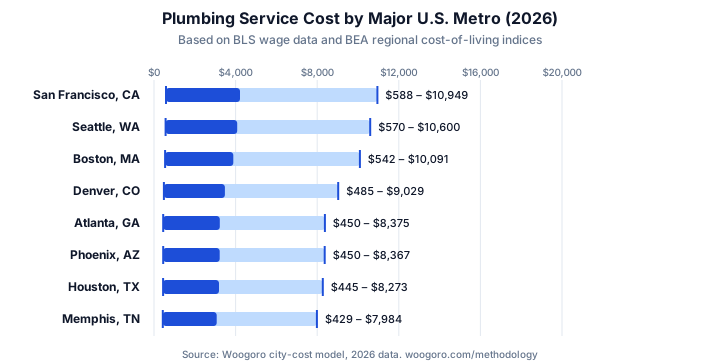
Average Plumbing Cost by Project (2026)
Plumbing prices are dominated by the project type, not the home's square footage. The table below shows installed cost by job, plus when each repair is typically needed.
| Service | Typical Range | When Needed |
|---|---|---|
| Drain cleaning (snake) | $150-$300 | Slow drain, single-fixture clog |
| Drain cleaning (hydro-jet) | $400-$900 | Main-line clog, root infiltration |
| Toilet replacement | $300-$800 | Cracked tank, chronic running, 15+ years old |
| Faucet/fixture install | $200-$600 | Kitchen, bath, or laundry fixture swap |
| Garbage disposal install | $250-$600 | Replace failed unit, new install |
| Tank water heater (40-50 gal) | $1,000-$3,500 | Unit 10+ years old, leaking, no hot water |
| Tankless water heater | $2,500-$6,500 | Endless hot water, gas conversion |
| Heat pump water heater | $2,000-$4,500 | Highest efficiency, IRA tax credit eligible |
| Slab leak repair | $1,000-$4,000 | Hot spot on floor, foundation moisture |
| Sump pump install | $800-$2,200 | Wet basement, hydrostatic pressure |
| Whole-home repipe (PEX) | $4,000-$15,000 | Galvanized failure, polybutylene removal |
| Whole-home repipe (copper) | $8,000-$18,000 | Premium durability, resale value |
| Sewer line replacement (excavation) | $3,000-$15,000 | Tree root damage, collapsed clay pipe |
| Sewer line replacement (trenchless) | $6,000-$25,000 | Minimal yard disruption, no driveway cut |
| Bathroom rough-in | $3,500-$8,500 | New bathroom or major remodel |
| Gas line install/extension | $500-$2,500 | New range, dryer, fireplace, generator |
Prices include parts, standard labor, and disposal of old fixtures. Permits, drywall patching, and code-required upgrades (expansion tanks, drain pans, sediment traps) are usually quoted separately.
Plumbing Cost by Job Size
The biggest cost driver after job type is total scope. Below are typical ranges for the three most common service tiers, plus what is included at each.
| Job Tier | Typical Total | What's Included |
|---|---|---|
| Service call (single fixture) | $150-$500 | Diagnostic, minor repair, snake or seal |
| Mid-job (single appliance) | $800-$3,500 | Water heater swap, slab leak, sump pump, garbage disposal + drain |
| Major repair (multiple fixtures) | $2,500-$8,000 | Multi-day work, drywall access, code upgrades, partial repipe |
| Whole-home (repipe or sewer) | $4,000-$25,000 | 3-7 day project, permits, drywall patch, full warranty |
| New construction or addition | $8,000-$25,000+ | Full rough-in, fixture set, gas line, code inspection |
Water Heater Cost: Tank vs. Tankless vs. Heat Pump
Water heater replacement is the most common five-figure-adjacent plumbing job homeowners face. The three technologies differ sharply in upfront cost, operating cost, and tax credit eligibility.
- Tank water heater ($1,000-$3,500 installed): 40 to 50 gallon gas or electric, 8 to 12 year lifespan. Cheapest upfront, simplest replacement (in-out swap, often a 4-hour job). Gas tanks need a 3-inch B-vent and may need a sediment trap and gas-rated shut-off retrofit if the existing setup pre-dates the current code.
- Tankless water heater ($2,500-$6,500 installed): Endless hot water, 20+ year lifespan, smaller wall-mount footprint. Gas tankless requires a larger gas line and a sealed combustion vent (concentric or twin-pipe). Total install premium over tank is usually $1,500-$3,000. Real annual savings vs. a 40-gallon tank are $50-$200, so payback is slow unless the household has high hot-water demand.
- Heat pump water heater ($2,000-$4,500 installed): 3-4x as efficient as resistance electric. Eligible for the IRA 25C tax credit (30% up to $2,000) and many utility rebates. Needs at least 700 cubic feet of conditioned space (a basement or large utility room) for the heat exchange to work. The fastest-growing category as of 2026.
- Conversion costs add up. Gas-to-tankless adds $500-$1,500 for venting and gas resizing. Tank-to-heat-pump adds $400-$1,000 for a 240V circuit if the existing tank was gas.
Rule of thumb: if you have natural gas and high hot-water demand, tankless wins on lifetime cost. If you have a basement and want maximum tax credit, heat pump wins. Otherwise, a same-fuel tank swap is the highest-ROI replacement.
Drain and Sewer Line Cost: Cleaning vs. Hydrojetting vs. Replacement
Drains follow a predictable progression. A first-time slow drain is usually a $200 snake job. A drain that re-clogs every 2 to 3 months is usually a sewer-line problem the snake will not fix. The ladder of severity is below.
- Snake / cable cleaning ($150-$300): A motorized cable breaks through soft clogs. Works for hair, grease, paper. Does not handle roots or scale. 90-day warranty is industry standard.
- Hydrojetting ($400-$900): 3,500-4,000 PSI water through a directional nozzle. Cuts roots and scale, scours pipe walls. Required when the snake re-clogs within weeks. Camera inspection should always be paired ($150-$400 alone, often free with the jetting).
- Sewer cleanout install ($350-$800): An accessible cleanout port near the foundation. Without one, every future drain job costs more. If you have an older home with no cleanout, this is a high-ROI upgrade.
- Sewer line spot repair ($1,500-$5,000): Excavation of a single offset joint or root intrusion. Best for isolated damage on otherwise sound clay or cast-iron lines.
- Sewer line replacement (excavation) ($3,000-$15,000): Trench from house to main, replace the lateral. Adds $1,000-$5,000 in landscaping repair plus driveway or sidewalk cuts at $5-$15 per square foot.
- Trenchless pipe-bursting ($6,000-$25,000): A bursting head pulls a new HDPE line through the old pipe, breaking the old as it goes. No yard trench. Higher per-foot cost but lower total when landscaping or hardscape would otherwise be destroyed.
- Trenchless pipe-lining (CIPP) ($4,000-$20,000): Epoxy liner cured inside the existing pipe. Works only if the pipe is structurally sound. Will not fix collapsed sections.
Always demand a sewer camera video before paying for replacement. A video shows the actual damage. Without one, you are letting the contractor diagnose and sell their own repair.
Fixture Installation Cost
Fixture replacements are the most price-shopped plumbing job and the easiest to overpay on. Standard scope is supply-line swap, fixture set, drain seal, and 30-minute leak test.
- Toilet swap ($300-$800): Removal, wax ring, supply line, set, level, leak test. Premium toilets (Toto Drake, Kohler Highline) cost $300-$700 for the unit plus the labor. ADA comfort-height adds $50-$150.
- Kitchen faucet ($200-$500): Old removal, supply lines, P-trap reconnect if needed. Pull-down sprayer adds $50-$100 in labor for the line.
- Bathroom faucet ($200-$450): Single-hole or 4-inch widespread. Widespread costs $50-$150 more in labor.
- Shower valve and trim ($400-$1,200): Pressure-balancing valve required by code in most jurisdictions since 2010. Wall access often required, adding drywall patch.
- Garbage disposal ($250-$600): Includes electrical disconnect, drain reroute, leak test. Continuous-feed standard; batch-feed adds $50-$100.
- Dishwasher hookup ($175-$400): Supply, drain hose, air gap (required in CA, MN, MI, HI, etc.), shut-off valve.
Whole-Home Repipe: PEX vs. Copper
Repipe is triggered by failing galvanized steel pipe (1950s-1960s homes), polybutylene class-action removal (1978-1995 homes), or pinhole leaks in copper from soft or aggressive water. The two modern choices are PEX and copper.
- PEX repipe ($4,000-$15,000): Cross-linked polyethylene tubing, manifold-fed home runs. 25-50 year manufacturer warranty. Fewer fittings (one per fixture vs. one per turn for copper). Freeze-tolerant. Faster install (3-5 days for a 2,000 sqft home). Industry default in 2026.
- Copper repipe ($8,000-$18,000): Type L copper with soldered or press fittings. 50-70 year lifespan. Better for outdoor exposure and main-line shutoff areas. Holds resale value better in some older neighborhoods. Sensitive to acidic water (pinholes in soft-water regions).
- Drywall patching: Repipe requires opening walls at every turn and tee. Patching is usually NOT included in the plumber's quote. Budget $1,000-$3,500 for drywall, paint, and trim restoration.
- Permit and inspection: Almost always required. Pulled by the plumber. $150-$600 fee.
- What gets included: All hot and cold supply lines from main to fixtures, new shut-off valves at each fixture, new pressure regulator if needed, hose bib replacement, and pressure test before drywall closes.
For a 2,000 sqft home, expect to pay $5,000-$8,000 for PEX or $10,000-$14,000 for copper, plus $1,500-$3,500 in drywall and paint. PEX is the right call for 90% of residential repipes.
What Should a Plumbing Quote Include?
Itemized quotes are the only way to compare plumbers fairly. Round-number quotes hide the same scope omissions over and over. A complete plumbing quote should list every line below.
- Diagnosis statement (what the plumber thinks is wrong, in writing)
- Parts (model number, brand, warranty term)
- Labor hours and hourly rate or flat-rate book
- Permit pulled by contractor (city, fee, expected inspection date)
- Code-required upgrades (expansion tank, drain pan, sediment trap, sealed combustion)
- Shut-off valves at each affected fixture
- Drywall and ceiling access plan (cuts, patches, who is responsible)
- Pressure testing before close-up
- Old equipment removal and disposal
- Cleanup of work area (drop cloths, vacuum)
- Workmanship warranty (1 year minimum, 2-5 years preferred)
- Manufacturer warranty (6-12 years on tanks, 25 years on PEX, lifetime on most fixtures)
- Emergency call-back terms (free for warranty work in the first 90 days)
- License number on the quote (verify it is active before signing)
- Insurance certificate (general liability + workers comp)
Hidden Plumbing Costs Most Homeowners Miss
Plumbing jobs blow budget more than most home repairs because the visible price covers the pipe work but not the supporting work. Watch for these.
- Permit fees ($50-$400): Often left off the base quote. Some plumbers ask the homeowner to pull the permit, which is a licensing red flag.
- Drywall and ceiling repair ($1,000-$3,500): Pipe access in walls and ceilings is rarely patched by the plumber. Budget a separate drywall and paint job afterward.
- Concrete cuts and patching on sewer work ($300-$2,000): Driveway, sidewalk, and basement slab cuts at $5-$15 per square foot. Patching is a separate concrete trade.
- Electrical for tankless or heat pump conversion ($300-$1,500): A new 240V circuit and breaker if converting from gas tank to heat pump or tankless.
- Code-required expansion tank ($150-$400): Required on any closed water-heating system since the early 2010s in most jurisdictions. Usually NOT included in a pure-swap water heater quote.
- Drain pan ($75-$250): Required under any water heater installed above a finished space. Often left off.
- Tile and floor repair after fixture removal ($200-$1,200): Toilet flanges, shower pans, and tub drains often damage adjacent tile during removal.
- Weekend and after-hours premiums (1.5x to 2x): Many plumbers charge time-and-a-half for evenings and double-time for Sundays. Confirm in writing.
- Service call fee ($75-$200): Some plumbers charge this even if you do not hire them. Ask up front.
- Parts markup (30-100%): Plumbers can mark up parts substantially. For high-ticket items (water heaters, fixtures, pumps) buying through Lowes or Ferguson and asking for an install-only quote can save 15-30%.
Plumbing Cost by City
Plumbing labor rates vary by metro because residential service work scales with local construction wages and licensing requirements. Below are 30 U.S. cities with their typical mid-job range (the $1,500-$3,500 national-median band, which covers water heater swaps, slab leak repairs, and partial repipes), plus the variance vs. the U.S. median. Click any city for full local pricing.
| City | Typical Mid-Job | vs. National Median |
|---|---|---|
| Atlanta, GA | $1,455-$3,395 | ~3% lower |
| Austin, TX | $1,500-$3,500 | at median |
| Baltimore, MD | $1,575-$3,675 | ~5% higher |
| Boston, MA | $1,830-$4,270 | ~22% higher |
| Charlotte, NC | $1,425-$3,325 | ~5% lower |
| Chicago, IL | $1,575-$3,675 | ~5% higher |
| Columbus, OH | $1,395-$3,255 | ~7% lower |
| Dallas, TX | $1,455-$3,395 | ~3% lower |
| Denver, CO | $1,575-$3,675 | ~5% higher |
| Detroit, MI | $1,425-$3,325 | ~5% lower |
| Houston, TX | $1,455-$3,395 | ~3% lower |
| Indianapolis, IN | $1,395-$3,255 | ~7% lower |
| Jacksonville, FL | $1,425-$3,325 | ~5% lower |
| Kansas City, MO | $1,395-$3,255 | ~7% lower |
| Las Vegas, NV | $1,530-$3,570 | ~2% higher |
| Los Angeles, CA | $1,830-$4,270 | ~22% higher |
| Memphis, TN | $1,320-$3,080 | ~12% lower |
| Miami, FL | $1,500-$3,500 | at median |
| Milwaukee, WI | $1,455-$3,395 | ~3% lower |
| Minneapolis, MN | $1,545-$3,605 | ~3% higher |
| Nashville, TN | $1,425-$3,325 | ~5% lower |
| New York, NY | $1,950-$4,550 | ~30% higher |
| Philadelphia, PA | $1,575-$3,675 | ~5% higher |
| Phoenix, AZ | $1,470-$3,430 | ~2% lower |
| Portland, OR | $1,575-$3,675 | ~5% higher |
| Raleigh, NC | $1,425-$3,325 | ~5% lower |
| San Antonio, TX | $1,425-$3,325 | ~5% lower |
| San Diego, CA | $1,770-$4,130 | ~18% higher |
| San Francisco, CA | $1,980-$4,620 | ~32% higher |
| Seattle, WA | $1,680-$3,920 | ~12% higher |
See plumbing pricing in 1,000+ U.S. cities → or browse the full plumbing cost guide for material deep-dives.
How to Get the Best Plumbing Quote
- Document the symptom in writing. When did it start, where, what have you tried? Photos and short videos help. Vague descriptions invite vague (and inflated) quotes.
- Get 2-3 written quotes for any job over $500. Same-day single-quote homeowners pay 20-40% above market on plumbing.
- Verify the diagnosis matches. If one plumber says repipe and two say repair, get a fourth opinion. Diagnosis-shopping is the single biggest savings lever.
- Itemize parts and labor separately. Flat-rate "books" (used by some chains) often mark up parts 100-200%. Hourly + parts at distributor cost is usually 20-40% cheaper.
- Confirm permit responsibility in writing. Plumber pulls the permit on water heaters, gas, sewer, and repipe. If they ask you to pull it, that is a licensing red flag.
- Check the warranty. 1 year labor minimum. PEX repipe should carry 25-year manufacturer plus 1-5 year labor. Tank water heaters carry 6-12 year tank warranties.
- Verify license and insurance. Active license number on the quote, current GL and workers comp certificate. Call the state board to confirm before signing.
- Pay schedule sanity-check. Service calls are typically pay-on-completion. Larger jobs use 25-50% deposit. Anything over 50% up front is a red flag.
Plumbing Quote Red Flags
- Service-call bait-and-switch. $49-$99 advertised service calls that turn into $700-$2,000 once the tech is on site. Always demand a written price before work starts.
- National drain-cleaning chains charging by the foot. Per-foot drain pricing scales the bill on jobs the tech finishes in 30 minutes. Get a flat-rate quote first.
- Water heater swap with no permit. Code requires a permit and inspection in most jurisdictions. Skipping it can void homeowners insurance after a leak.
- Inflated parts markup (100%+ over Home Depot retail). A 50% markup is typical. 200% is well above benchmark. Spot-check the model number on the quote.
- Pressure to replace when repair is possible. A $4,000 repipe sale is more profitable than a $400 spot repair. Get a second opinion on any "complete replacement" recommendation.
- Weekend rate quoted as standard. 1.5x to 2x premiums are normal for nights and weekends but should be disclosed up front, not surprise-billed.
- Same-day pressure to sign. Legitimate plumbers hold pricing 30 days. High-pressure tactics correlate with overpriced jobs.
- Cash-only or unusual payment. Anything that bypasses normal accounting is a fraud risk.
- No license number on the quote. A legitimate plumber lists their state license on every estimate.
- Below-market quote (30%+ under others). Usually missing scope, permits, or proper licensing.
Plumbing Permits and Code Notes
Most U.S. cities require a permit for water heater replacement, gas line work, sewer line replacement, repipes, and any work behind walls. Permit fees usually run $50 to $400, processed in 1 to 3 weeks. The plumber should pull the permit. If they ask you to pull it, that is a licensing red flag.
Beyond the permit, three things commonly trip up homeowners on plumbing jobs:
- Expansion tanks are now code in most jurisdictions. Any closed water-heating system requires one. Adds $150-$400 to a water heater swap. Skipping it can void the manufacturer warranty.
- Backflow prevention. Required on irrigation systems and many water-main connections. $200-$600 for residential. Annual inspection is required by some water utilities.
- Cross-connection rules. Dishwasher air gaps, hose-bib vacuum breakers, and boiler-feed backflow are checked by city inspectors and often missed by handymen.
If you are buying a home with a documented water heater or repipe, request the permit number and final inspection sign-off. Without those, the work is essentially undisclosed on resale.
How Much Can You Save on Plumbing?
Realistic savings levers, ranked by effort vs. payoff:
- Get 2-3 quotes on jobs over $500 (saves 15-30%). Single-quote homeowners pay roughly 20-40% above market for plumbing. Highest-ROI move.
- Diagnosis-shop on big jobs (saves 50-90% when applicable). If one plumber says repipe and two say repair, the repair is often the right call. A second opinion is cheap.
- Buy fixtures yourself (saves 15-30% on parts). Toilets, faucets, water heaters, and disposals are commodity parts. Lowes/Home Depot/Ferguson retail is usually 30-50% under plumber pricing.
- Avoid weekend and after-hours calls (saves 50-100%). Schedule for weekday daytime if it is not a true emergency.
- Bundle visits (saves $75-$200 per visit). Service-call fees are per-trip. Consolidate the leaky faucet, the running toilet, and the slow drain into one visit.
- DIY easy fixes. Toilet flapper and fill valve, cartridge swap on a leaky faucet, P-trap clearing, garbage disposal reset. 90% of "running toilet" calls are a $15 flapper.
- Off-season scheduling (saves 5-10%). Late spring and early fall, away from frozen-pipe season and AC-overflow season.
- Maintain instead of replace. Drain the water heater annually. Flush the tankless once a year. Run hot water through unused fixtures monthly. Doubles the service life of most equipment.
Plumbing FAQ
How much does plumbing work cost in 2026?
Plumbing project costs range from $150 to $15,000 in 2026 depending on scope. Drain cleaning runs $150 to $500. Water heater replacement averages $1,000 to $3,500. Whole-home repipe runs $4,000 to $15,000 (PEX) or $8,000 to $18,000 (copper). Sewer line replacement ranges $3,000 to $25,000. Most homeowners spend $400 to $2,500 on a typical service call.
How much is a water heater replacement?
Standard 40-50 gallon tank water heater replacement costs $1,000 to $3,500 installed in 2026. Tankless water heater replacement runs $2,500 to $6,500. Heat pump water heaters cost $2,000 to $4,500 (eligible for federal tax credits up to $2,000 under the IRA). Labor is typically $400 to $800 of the total. Gas-to-tankless conversion adds $500 to $1,500 for venting upgrades and gas line resizing, plus electrical for the unit's controls.
How much does it cost to repipe a house?
Whole-home repipe costs $4,000 to $15,000 for PEX or $8,000 to $18,000 for copper in 2026. PEX is the dominant choice for residential repipes (faster install, fewer fittings, more freeze-tolerant). A typical 2,000-square-foot home takes 3 to 5 days. Most repipes are triggered by polybutylene removal, galvanized pipe failure, or pinhole copper leaks in soft-water regions. Drywall patching after pipe access usually adds $1,000 to $3,500.
How much does drain cleaning cost?
Standard drain cleaning costs $150 to $500 in 2026. Snake-only service runs $150 to $300. Hydro-jetting (high-pressure water) costs $400 to $900 and is required for serious clogs or root infiltration. Sewer line cleaning with camera inspection runs $300 to $700. Watch for chains that bid $99 then upcharge to $700 once the tech is on site. A reputable plumber gives a written price before starting.
How much does sewer line replacement cost?
Sewer line replacement costs $3,000 to $25,000 in 2026 depending on length, depth, and access. Trenchless pipe-bursting averages $80 to $200 per linear foot. Traditional excavation averages $50 to $200 per linear foot but adds $1,000 to $5,000 in landscaping repair, plus driveway or sidewalk concrete cuts at $5 to $15 per square foot. Most residential lateral sewer lines run 50 to 100 feet from house to main.
Do I need a permit for plumbing work?
Most cities require a permit for water heater replacement, gas line work, sewer line replacement, repipes, and any work behind walls. Permit fees usually run $50 to $400. Lamp-and-fixture swaps and faucet replacements typically do not require permits. The contractor should pull the permit. If they ask you to pull it, that is a licensing red flag. A water heater installed without a permit can void homeowners insurance after a leak.
Why is my water bill so high?
The most common cause of a sudden high water bill is a running toilet (can waste 200 gallons per day), a slab leak (often invisible but adds 30 to 100 percent), or an irrigation system stuck on. Check your meter with all water shut off. If it spins, you have a leak. Whole-home water leak detection costs $200 to $500 and pinpoints the source in 1 to 2 hours. Slab leak repair runs $1,000 to $4,000 depending on access.
What is the difference between PEX and copper repipe?
PEX repipe runs $4,000 to $15,000 and is the residential default in 2026: flexible, freeze-tolerant, 50-year warranties common, fewer fittings, faster install. Copper repipe runs $8,000 to $18,000, lasts 50 to 70 years, and holds resale value better in older neighborhoods. Copper still wins for outdoor exposure and main-line shut-off areas. PEX has been code-approved nationwide since the 2010s and is what most plumbers will recommend for an interior repipe.
See if your plumbing quote is fair
Upload your contractor quote and we'll compare it against city wage data, flag missing scope, and tell you the realistic price range for your exact project. Free, no email required.
How We Calculate Plumbing Costs
Every per-project and per-city range on this page is built from three public datasets: Bureau of Labor Statistics Occupational Employment and Wage Statistics for plumbers, pipefitters, and steamfitters, Bureau of Economic Analysis Regional Price Parities for material adjustments, and 2026 retail material pricing from major U.S. plumbing distributors (Ferguson, Home Depot Pro, Lowe's Pro). Ranges represent the middle 60-70% of typical residential quotes, not the extremes. Read our full methodology for details on how city multipliers are derived.