

Medical Cost Guide 2026
What common medical procedures typically cost in 2026, how to read your bill, and how to question charges that exceed benchmark rates.
Prices based on CMS Medicare Physician Fee Schedule 2026 and RAND commercial rate studies. Covers 146 procedure codes across 13 categories. This guide is informational only and does not constitute medical, insurance, or legal advice.
Emergency & Urgent Care Costs
Emergency rooms are the most expensive place to receive care. Knowing the baseline helps you spot inflated charges after the fact.
| Service | Medicare Rate | Typical Bill | Typical Range with Insurance |
|---|---|---|---|
| ER visit (moderate) | $150 | $500–$1,500 | $200–$800 with insurance |
| ER visit (severe) | $350 | $1,500–$4,000 | $500–$2,000 with insurance |
| Urgent care visit | $110 | $150–$350 | $25–$75 copay |
Imaging Costs
Imaging is one of the biggest areas where prices vary wildly for the exact same service. The machine, the technician, and the radiologist reading the scan can all be identical, but the bill depends entirely on where you go.
| Service | Medicare Rate | Hospital Price | Imaging Center Price |
|---|---|---|---|
| Brain MRI (with contrast) | $350 | $1,500–$3,500 | $400–$800 |
| Knee MRI | $280 | $1,200–$3,000 | $350–$700 |
| CT abdomen/pelvis | $250 | $800–$2,500 | $300–$600 |
| Chest X-ray | $30 | $150–$400 | $50–$100 |
Lab Work Costs
Hospital labs routinely charge 5–10x what independent labs charge for the same routine blood tests, making this category one of the largest sources of potential billing inflation that consumers can address by choosing where the work is done.
| Test | Medicare Rate | Hospital Lab | Quest/Labcorp Cash |
|---|---|---|---|
| CBC (blood count) | $11 | $50–$150 | $10–$25 |
| Metabolic panel | $14 | $75–$200 | $15–$30 |
| Lipid panel | $18 | $50–$150 | $20–$40 |
| Urinalysis | $5 | $25–$100 | $5–$15 |
Surgery Costs
Surgical costs vary enormously depending on where the procedure is performed. Ambulatory Surgery Centers (ASCs) offer a dramatically lower-cost alternative to hospitals for many common procedures.
| Procedure | Medicare Pays | Typical Total Cost | ASC Alternative |
|---|---|---|---|
| Knee replacement | $18,000 | $30,000–$70,000 | $15,000–$25,000 |
| Hip replacement | $17,000 | $30,000–$65,000 | $15,000–$25,000 |
| Gallbladder removal | $5,500 | $8,000–$25,000 | $5,000–$10,000 |
| Hernia repair | $4,000 | $5,000–$18,000 | $3,000–$8,000 |
| Colonoscopy | $0 (screening) | $1,500–$5,000 | $1,000–$2,500 |
Same Procedure, Different Price: Facility Comparison
Where you get a procedure done can matter more than what procedure you get. The same MRI costs 40-60% less at a freestanding imaging center vs a hospital outpatient department.
| Setting | vs Hospital Outpatient | Example |
|---|---|---|
| Hospital Outpatient | Baseline | Brain MRI: $1,500-3,500 |
| Ambulatory Surgery Center | 42% less | Colonoscopy: $1,089 vs $1,766 |
| Freestanding Imaging Center | 40-60% less | Brain MRI: $400-800 |
| Physician Office | 55% less | No facility fee added |
| Emergency Room | 180% more | Same X-ray: $350 vs $75 |
Source: CMS OPPS/ASC rates 2026, JAMA Health Forum colonoscopy study
Maternity Costs
Having a baby is one of the most expensive medical events for American families. Costs vary widely by hospital, region, and delivery method.
| Service | Medicare Equivalent | Typical Total |
|---|---|---|
| Vaginal delivery (total) | $7,000 | $10,000–$25,000 |
| C-section (total) | $10,000 | $15,000–$45,000 |
| Epidural | $400 | $1,500–$4,000 |
How to Read Your Medical Bill
Medical bills are notoriously complex. Understanding these key concepts will help you identify potential billing errors and charges that exceed benchmark rates.
- EOB vs final bill. Your Explanation of Benefits (EOB) from your insurer is not a bill. It shows what was billed, what insurance paid, and what you may owe. Wait for the actual bill from the provider before paying anything.
- CPT codes. Current Procedural Terminology codes are the standardized billing codes for every medical service. Every charge on your bill should have one. If it does not, request an itemized bill with CPT codes.
- Facility fee vs professional fee. This is why you get two bills for one visit. The hospital charges a facility fee for use of the room and equipment. The doctor charges a separate professional fee for their time. Both should be itemized.
- Allowed amount vs billed amount. The billed amount is the hospital's sticker price (chargemaster rate). The allowed amount is what your insurance has negotiated. You should never pay more than the allowed amount minus what insurance already covered.
- Patient responsibility. This is the only number that matters: the amount you actually owe after insurance payments and adjustments. It includes your deductible, copay, and coinsurance.
- Coordination of benefits. If you have two insurance plans (for example, through your employer and your spouse's employer), the primary plan pays first and the secondary plan may cover some or all of the remainder. Make sure both insurers are billed.
Red Flags on Your Medical Bill
Studies estimate that up to 80% of medical bills contain errors. Here are the most common problems to look for.
- Charges for services you did not receive. Compare the bill line by line against your own records. Were you actually given that medication? Did that test actually happen?
- Duplicate charges. The same CPT code billed twice on the same date of service. This is one of the most common billing errors.
- Upcoding. A routine office visit (CPT 99213) billed as a complex visit (CPT 99215). This inflates the charge by 2–3x for the same appointment.
- Unbundling. A single procedure split into multiple separate codes to increase the total. For example, billing each component of a metabolic panel individually instead of using the panel code.
- Facility fee on an office visit. If you visited a doctor's office that is owned by a hospital, you may see a facility fee that would not exist at an independent practice. This is legal but worth questioning.
- Screening reclassified as diagnostic. A routine screening colonoscopy or mammogram should be covered at 100% under the ACA. If a polyp is found or a biopsy taken, the visit may be reclassified as "diagnostic," triggering cost-sharing. This is increasingly being challenged.
- Balance billing from an in-network provider. If your provider is in-network, they cannot bill you for the difference between their charge and the allowed amount. If you see this, dispute it immediately.
- "Miscellaneous" or "other" charges. Any charge without a clear description or CPT code should be questioned. Request a full itemization.
How to Dispute a Medical Bill
You have more leverage than you think. Follow these steps in order, and do not pay until you are satisfied the bill is accurate and fair.
- Request an itemized bill with CPT codes. Call the billing department and ask for a detailed, line-by-line bill showing every CPT code, description, and charge. You are legally entitled to this.
- Compare each charge to Medicare rates. Medicare rates are the closest thing to a "fair price" benchmark. If a charge is more than 2–3x the Medicare rate, you have strong grounds to negotiate.
- Call the billing department and reference specific line items. Be polite but specific. Say "I see CPT 99215 billed at $450, but this was a routine follow-up. Can you review the coding?" Specificity gets results.
- Ask for the cash/self-pay discount. If they will not adjust individual charges, ask what the self-pay or prompt-pay discount is. Most hospitals offer 30–60% off the total for cash payment. This often brings the bill close to what insurance would have paid.
- File a formal appeal with your insurance. If your insurer denied coverage or underpaid, file a written appeal. Include your itemized bill, any supporting medical records, and a clear explanation of why the claim should be covered.
- Contact your state insurance commissioner. If your insurer is not responding to appeals, your state Department of Insurance can intervene. They take consumer complaints seriously and have regulatory authority over insurers.
- Consider a medical billing advocate. Professional billing advocates charge $100–$200/hr but often save 10x their fee. They know the billing codes, the appeal processes, and the negotiation tactics. Worth it for bills over $5,000.
- Know your rights. The No Surprises Act protects against surprise out-of-network bills. The ACA guarantees free preventive care. Many states have additional patient billing protections. Your state attorney general's office can tell you what applies.
Medical Costs by City
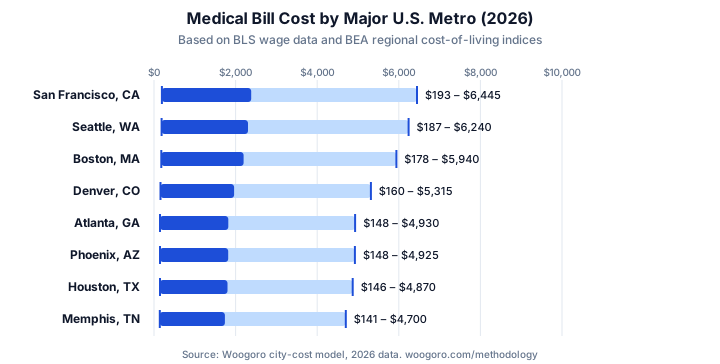
Hospital and ER pricing tracks the local concentration of academic medical centers, regional cost-of-living, and the mix between safety-net hospitals and private health systems. The ranges below cover a moderate-acuity ER visit (CPT 99283–99284, level 3–4) — the most common emergency-department billing tier and the metric most consumers will actually encounter. The same visit at an academic medical center typically runs 2–3× the price at a community or safety-net hospital in the same metro. Click any city for a deeper breakdown by procedure, hospital system, and freestanding-facility alternatives.
| City | ER Visit (moderate, typical billed) | vs. National Median |
|---|---|---|
| Atlanta, GA | $1,000–$2,000 | ~25% higher |
| Austin, TX | $950–$1,850 | ~15% higher |
| Boston, MA | $1,800–$3,200 | ~110% higher |
| Charlotte, NC | $800–$1,600 | at median |
| Chicago, IL | $1,300–$2,500 | ~60% higher |
| Cincinnati, OH | $650–$1,350 | ~20% lower |
| Dallas, TX | $1,000–$2,000 | ~25% higher |
| Denver, CO | $1,000–$2,000 | ~25% higher |
| Detroit, MI | $750–$1,550 | ~5% lower |
| Houston, TX | $1,000–$2,000 | ~25% higher |
| Indianapolis, IN | $700–$1,400 | ~15% lower |
| Las Vegas, NV | $900–$1,700 | ~10% higher |
| Los Angeles, CA | $1,700–$3,000 | ~95% higher |
| Memphis, TN | $650–$1,350 | ~20% lower |
| Miami, FL | $1,200–$2,300 | ~45% higher |
| Minneapolis, MN | $950–$1,850 | ~15% higher |
| Nashville, TN | $800–$1,600 | at median |
| New York, NY | $2,000–$3,500 | ~130% higher |
| Philadelphia, PA | $1,200–$2,200 | ~40% higher |
| Phoenix, AZ | $850–$1,650 | ~5% higher |
| Pittsburgh, PA | $700–$1,500 | ~10% lower |
| Portland, OR | $1,000–$2,000 | ~25% higher |
| Sacramento, CA | $1,250–$2,350 | ~50% higher |
| San Diego, CA | $1,500–$2,800 | ~80% higher |
| San Francisco, CA | $2,000–$3,500 | ~130% higher |
| Seattle, WA | $1,500–$2,800 | ~80% higher |
| St. Louis, MO | $700–$1,400 | ~15% lower |
| Tampa, FL | $850–$1,650 | ~5% higher |
Severe ER visits (level 5, CPT 99285) typically run 2–3× these ranges. See medical cost data for all U.S. cities → or browse the full city directory across every cost vertical.
Think Your Medical Bill Has Errors?
Upload your medical bill and get a free analysis. We compare every charge against published Medicare benchmark rates and flag potential billing errors, possible upcoding patterns, and charges that significantly exceed those benchmarks for you to consider questioning.
Upload Your Medical Bill for Free AnalysisFrequently Asked Questions
How do I know if my medical bill has errors?
Studies suggest that up to 80% of medical bills contain errors. The most common are duplicate charges, upcoding (billing a routine visit as a complex one), unbundling (splitting one procedure into multiple codes), and charges for services never rendered. Request an itemized bill with CPT codes and compare each line item against Medicare rates. Any charge that seems disproportionately high or does not match the care you received is worth questioning.
What is the No Surprises Act?
The No Surprises Act is a federal law that took effect January 1, 2022. It protects patients from surprise medical bills when they receive emergency care, or when they receive care at an in-network facility from an out-of-network provider they did not choose (such as an anesthesiologist or radiologist). Under this law, you can only be charged in-network cost-sharing amounts in these situations. It also requires providers to give good-faith cost estimates before scheduled care.
Can I negotiate my medical bill?
Yes, always. Hospitals and providers expect negotiation. Most hospitals have financial assistance (charity care) programs for patients who qualify. Even if you do not qualify for charity care, most billing departments will offer a 30–60% discount for prompt cash payment. You can also negotiate a payment plan with zero interest. The key is to call before the bill goes to collections and to reference specific line items rather than just asking for a general discount.
What is the difference between billed amount and allowed amount?
The billed amount (also called the chargemaster rate) is the hospital's full sticker price. Nobody actually pays this amount. The allowed amount is the price your insurance company has negotiated with the provider. Your out-of-pocket cost is based on the allowed amount, not the billed amount. If you see "patient responsibility" calculated from the billed amount rather than the allowed amount, that is an error you should dispute.
Should I pay my medical bill right away?
No. Review it first. You typically have 30–90 days before a bill is sent to collections. Use that time to request an itemized bill, verify every charge, compare against your EOB, and dispute any errors. Paying immediately waives your ability to contest charges later. Once you are satisfied the bill is accurate, ask about prompt-pay discounts before submitting payment.
What is a CPT code?
Current Procedural Terminology (CPT) codes are standardized five-digit codes maintained by the American Medical Association. Every medical service, test, and procedure has a unique CPT code. These codes determine how much providers bill and how much insurance pays. Knowing the CPT code for your service lets you look up the Medicare reimbursement rate and compare it to what you were charged. Common examples: 99213 (standard office visit), 70553 (brain MRI with contrast), 85025 (complete blood count).
What is the No Surprises Act and how does it protect me?
The No Surprises Act (effective January 2022) protects patients from surprise medical bills. Key protections: emergency services must be billed at in-network rates regardless of provider network status; out-of-network providers at in-network facilities cannot balance bill without prior written consent; and if your final bill exceeds a good faith estimate by $400 or more, you can dispute it through an independent review process. File complaints at cms.gov/nosurprises or call 1-800-985-3059.