

Legal Fee Guide 2026
What attorneys typically charge by practice area in 2026, how fee structures work, and how to evaluate legal fees against benchmark rates.
Rates based on Clio Legal Trends Report 2025, LawPay state data, and bar association fee surveys. Covers 15 practice areas with state-level pricing for all 50 states. This guide is informational only and does not constitute legal advice. Woogoro is not a lawyer referral service.
Hourly Rates by Practice Area
Attorney hourly rates vary dramatically based on firm size, geography, and specialization. This table shows national ranges for 2026.
| Practice Area | Solo / Small Firm | Midsize Firm | Large Firm / BigLaw |
|---|---|---|---|
| Family Law | $150–$350 | $300–$500 | $450–$800 |
| Criminal Defense | $150–$400 | $350–$600 | $500–$1,000 |
| Estate Planning | $150–$350 | $300–$450 | $400–$700 |
| Real Estate | $150–$350 | $300–$450 | $400–$700 |
| Business Law | $200–$400 | $350–$600 | $500–$1,200 |
| Immigration | $150–$350 | $300–$450 | $400–$650 |
| Bankruptcy | $150–$300 | $250–$400 | $350–$600 |
| IP / Patent | $250–$450 | $400–$650 | $600–$1,200 |
| Tax Law | $200–$400 | $350–$600 | $500–$1,000 |
Common Flat Fee Services
Many routine legal services are offered at flat fees. These ranges reflect what attorneys typically charge nationwide in 2026.
| Service | Typical Range |
|---|---|
| Simple will | $300–$1,000 |
| Living trust | $1,500–$5,000 |
| LLC formation | $500–$2,000 |
| Uncontested divorce | $1,500–$5,000 |
| DUI (first offense) | $2,500–$7,500 |
| Chapter 7 bankruptcy | $1,000–$3,500 |
| Chapter 13 bankruptcy | $2,500–$6,000 |
| Trademark registration | $1,000–$3,000 |
| Green card (family-based) | $3,000–$8,000 |
| Prenuptial agreement | $1,500–$5,000 |
Fee Structures Explained
Attorneys use several different billing models. Understanding how each one works helps you evaluate whether a fee agreement is fair.
Hourly Billing
The most common structure. You pay for the attorney's time in increments, typically six minutes (one-tenth of an hour). A five-minute phone call billed in six-minute increments costs 0.1 hours. Every email, phone call, court appearance, and document review is tracked and billed. Ask for monthly itemized invoices so you can review each entry.
Flat Fees
A single price for a defined scope of work. Common for predictable tasks like wills, LLC formations, uncontested divorces, and trademark filings. The advantage is cost certainty. The risk is that the scope may be too narrow, and anything outside it reverts to hourly billing. Always confirm what triggers additional charges.
Contingency Fees
The attorney takes a percentage of your recovery instead of charging upfront. Standard contingency fees range from 25% to 40%, with 33% being most common. If you lose, you owe no attorney fee, but you may still owe case expenses (filing fees, expert witnesses, depositions). Always clarify whether the percentage is calculated before or after expenses are deducted.
Retainer
An upfront deposit placed into a trust account. The attorney draws against it as work is performed. When the balance drops below a threshold, you replenish it. The retainer itself is not a fee. It is your money held in trust until earned. Any unearned portion must be refunded when representation ends. Ask about the replenishment threshold and how often you receive account statements.
Hybrid Structures
Some attorneys combine models. A reduced hourly rate plus a smaller contingency percentage. A flat fee for the initial phase plus hourly billing if the case goes to trial. Hybrid arrangements can align incentives well, but make sure the agreement clearly defines when each billing method applies and what triggers the transition.
What Your Retainer Agreement Should Include
Before you sign a fee agreement, confirm it covers all of the following. A complete agreement protects both you and your attorney.
- Scope of representation: exactly what legal matter the attorney is handling
- Fee structure: hourly rate, flat fee, contingency percentage, or hybrid terms
- Billing increment: the minimum time unit charged (six minutes is standard and fair)
- Retainer amount and replenishment threshold
- Estimated total cost or budget range for the matter
- What expenses you are responsible for (filing fees, expert witnesses, travel, copies)
- Billing frequency and how you will receive invoices
- How to terminate the relationship and what happens to the unused retainer
- Who will actually do the work (partner, associate, paralegal) and their respective rates
- Dispute resolution process if you disagree with a bill
Red Flags in Legal Fee Agreements
Not every fee agreement is fair. Watch for these warning signs before you sign.
- Non-refundable retainer. Ethical rules in most states require attorneys to refund unearned portions of a retainer. A "non-refundable" retainer is a red flag and may violate state bar rules.
- 15-minute billing increments. The industry standard is six minutes. A firm billing in 15-minute increments means a two-minute email costs you a quarter hour. This adds up fast.
- Vague scope of work. If the agreement does not clearly define what the attorney will handle, you have no way to know when additional charges are justified.
- Clerical tasks billed at attorney rates. Photocopying, scanning, scheduling, and filing should not be billed at $300/hour. These tasks should be handled by support staff at lower rates or included in overhead.
- No termination clause. You should always have the right to end representation. An agreement that locks you in or imposes steep penalties for termination is unreasonable.
- No estimated total cost. An attorney who refuses to provide even a rough budget range may not have enough experience with your type of case, or may not want you to track spending.
- Requiring payment of opponent's fees. Unless you are in a jurisdiction where loser-pays is standard, your agreement should not obligate you to cover opposing counsel's fees.
- Flat fee with no refund for early resolution. If you pay a flat fee for a case that settles quickly, a fair agreement should address partial refunds or credit for the unused portion.
Common Billing Abuses and How to Spot Them
Studies show 55% of attorneys acknowledge that bill padding occurs in their profession. Here are the most common tactics and how to identify them on your invoice.
| Abuse Type | What It Looks Like | Impact |
|---|---|---|
| Block Billing | "Research, draft motion, review file, conference call - 4.5 hrs" | Courts reduce block-billed fees 20-30%. You cannot verify hours per task. |
| Vague Entries | "Research" or "Review file" or "Attention to matter" | Impossible to evaluate if time was reasonable. |
| Paralegal Work at Attorney Rate | Filing, copying, scheduling billed at $300+/hr | Industry-standard paralegal rates typically range $75-175/hr; many firms absorb routine paralegal work as overhead. Rates 3-5x higher than that range may be worth questioning. |
| 15-Minute Increment Padding | Every email and call billed as 0.25 hours | A 2-minute email at $350/hr costs $87.50 instead of $11.67 at 6-min increments. |
| Overhead as Expenses | Copies at $0.25-1.00/page, fax charges, Westlaw fees | Actual copy cost is $0.03/page. These are firm overhead, not billable expenses. |
| Double Billing | Two attorneys billing for attending the same meeting | You pay twice for one conversation. Ask why both were needed. |
Our Legal Fee Analyzer automatically detects these patterns in uploaded invoices and retainer agreements.
Free and Low-Cost Legal Help
If attorney fees are beyond your budget, these resources provide free or reduced-cost legal assistance.
| Resource | Who Qualifies | What They Provide |
|---|---|---|
| Legal Aid (LSC) | Income below 125% FPL (~$20K single) | Full representation in civil matters |
| ABA Free Legal Answers | Income below 250% FPL (~$40K single) | Free online Q&A with volunteer attorneys |
| Law School Clinics | Varies (often income-based) | Free representation by supervised law students |
| Bar Referral Programs | Open to all | Reduced-fee initial consultations ($25-50) |
| Court Self-Help Centers | Open to all | Forms, workshops, guidance for self-representation |
Visit LawHelp.org to find free legal help in your state.
How to Negotiate Legal Fees
Attorney fees are not set in stone. Most lawyers expect some negotiation, especially for new client relationships.
- Always get a written fee agreement. Verbal arrangements lead to disputes. Every state bar recommends or requires written agreements. If an attorney resists putting terms in writing, find another attorney.
- Ask about billing increments. Push for six-minute (0.1 hour) increments. If a firm uses 15-minute increments, ask them to switch. Many will.
- Request a budget estimate range. Ask for best-case and worst-case total cost estimates. An experienced attorney should be able to provide a reasonable range based on similar past matters.
- Ask if junior associates or paralegals can handle routine tasks. Research, document review, and filing do not require a senior partner. Rates for associates and paralegals are typically 40–60% lower.
- Negotiate flat fees for predictable work. Wills, formations, trademark filings, and uncontested matters have predictable scopes. A flat fee eliminates billing uncertainty for both sides.
- Ask about payment plans. Many attorneys offer monthly payment plans, especially for family law and criminal defense matters. Some accept credit cards, though a processing fee may apply.
- Get two to three consultations. Many attorneys offer free initial consultations. Use them to compare rates, communication styles, and experience levels before committing.
Legal Fees by City
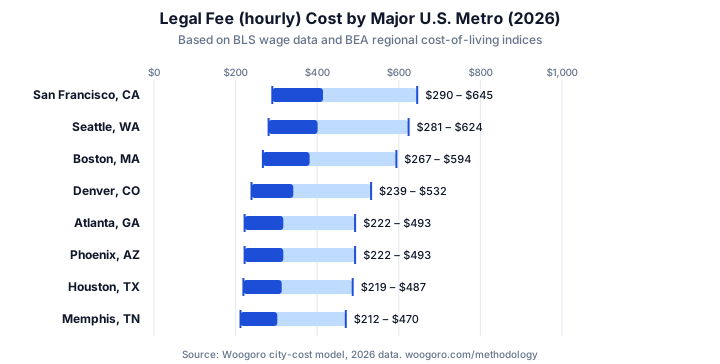
Attorney rates track local cost-of-living, regulatory complexity, and the concentration of large firms in each metro. The hourly ranges below cover solo practitioners and small-firm general practice across 28 U.S. cities — the band most individuals encounter for wills, family law, criminal defense, immigration, and small-business matters. Specialty work (BigLaw partners, IP, M&A, energy regulatory) typically runs 2–3× these numbers. Click any city for a deeper breakdown by practice area, flat-fee options, and local legal-aid resources.
| City | Solo / General Practice (hourly) | vs. National Median |
|---|---|---|
| Atlanta, GA | $250–$475 | ~5% lower |
| Austin, TX | $250–$475 | ~5% lower |
| Boston, MA | $325–$575 | ~15% higher |
| Charlotte, NC | $225–$450 | ~10% lower |
| Chicago, IL | $300–$550 | ~10% higher |
| Cincinnati, OH | $200–$400 | ~18% lower |
| Dallas, TX | $250–$500 | at median |
| Denver, CO | $250–$475 | ~5% lower |
| Detroit, MI | $225–$425 | ~13% lower |
| Houston, TX | $250–$500 | at median |
| Indianapolis, IN | $200–$400 | ~18% lower |
| Las Vegas, NV | $250–$450 | ~8% lower |
| Los Angeles, CA | $325–$600 | ~20% higher |
| Memphis, TN | $200–$400 | ~18% lower |
| Miami, FL | $275–$500 | ~3% higher |
| Minneapolis, MN | $250–$475 | ~5% lower |
| Nashville, TN | $225–$450 | ~10% lower |
| New York, NY | $400–$650 | ~30% higher |
| Philadelphia, PA | $275–$500 | ~3% higher |
| Phoenix, AZ | $225–$450 | ~10% lower |
| Pittsburgh, PA | $225–$425 | ~13% lower |
| Portland, OR | $250–$475 | ~5% lower |
| Sacramento, CA | $275–$500 | ~3% higher |
| San Diego, CA | $300–$525 | ~7% higher |
| San Francisco, CA | $400–$650 | ~30% higher |
| Seattle, WA | $300–$525 | ~7% higher |
| St. Louis, MO | $200–$400 | ~18% lower |
| Tampa, FL | $250–$450 | ~8% lower |
See legal fee data for all U.S. cities → or browse the full city directory across every cost vertical.
Not Sure If Your Legal Fees Are Fair?
Upload your fee agreement or retainer letter and get a free analysis of the rates, billing terms, and potential red flags.
Analyze My Fee AgreementFrequently Asked Questions
How much does a divorce lawyer cost?
A divorce lawyer typically costs $150–$500 per hour depending on firm size and location. An uncontested divorce with a solo practitioner may cost $1,500–$5,000 total. A contested divorce with custody disputes, asset division, and trial can run $15,000–$50,000 or more. The single biggest factor in total cost is whether the divorce is contested. Mediation and collaborative divorce approaches can significantly reduce legal fees.
What is a fair hourly rate for an attorney?
A fair hourly rate depends on the practice area, the attorney's experience, and the firm size. Solo practitioners and small firms typically charge $150–$400 per hour. Midsize firms charge $250–$600. Large firms and BigLaw charge $400–$1,200 or more. Specialized areas like patent law and complex litigation command higher rates. For most consumer legal needs (family law, estate planning, real estate closings), a solo or small firm attorney in the $200–$350 range is reasonable.
Should I hire a solo practitioner or a large firm?
For most consumer legal matters, a solo practitioner or small firm offers the best value. You get direct access to your attorney, lower overhead costs, and more personalized attention. Large firms are worth the premium for complex corporate transactions, high-stakes litigation, or matters requiring specialized teams across multiple jurisdictions. The key question is whether your case actually needs the resources of a large firm. A straightforward will, divorce, or DUI defense rarely does.
What is a retainer and how does it work?
A retainer is an upfront deposit you pay before legal work begins. The money is held in the attorney's trust account (also called an IOLTA account). As the attorney works on your case, they bill against the retainer balance. You receive periodic statements showing how the retainer is being drawn down. When the balance drops below a set threshold, you replenish it. Any unearned portion must be returned to you when representation ends. A retainer is not a fee. It is your money held in trust until the attorney earns it through documented work.
Can I negotiate attorney fees?
Yes. Attorney fees are negotiable in most situations. You can negotiate the hourly rate, the billing increment, the retainer amount, payment terms, and whether certain work can be handled by lower-cost associates or paralegals. Attorneys expect negotiation, particularly for new client relationships and larger matters. Getting two to three consultations gives you leverage to compare rates. Many attorneys will also match or beat a competitor's quote for comparable services.
What is the difference between hourly and flat fee?
Hourly billing means you pay for the attorney's time in increments (typically six minutes). Your total cost depends on how long the matter takes. Flat fee means you pay one set price for a defined scope of work, regardless of how long it takes the attorney. Flat fees work best for predictable tasks like drafting a will, forming an LLC, or handling an uncontested divorce. Hourly billing is more common for unpredictable matters like contested litigation, where the scope and duration depend on the other party's actions.