
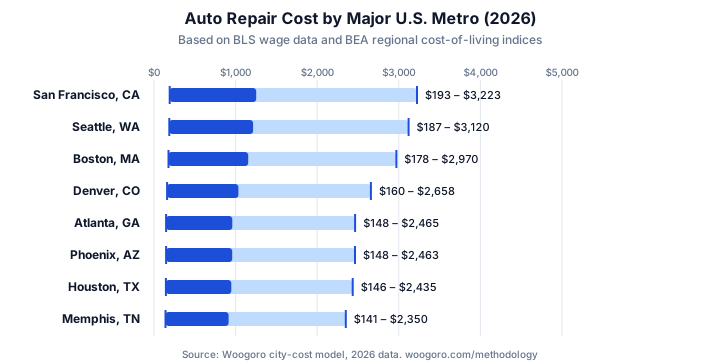

Auto Repair Cost Guide 2026
What common auto repairs should actually cost, how to read a mechanic's quote, and how to tell a fair price from a ripoff.
Common Auto Repair Costs in 2026
These are typical all-in prices (parts + labor) for mainstream vehicles at independent shops. Luxury, European, and trucks with limited access may run 20–50% higher.
| Repair | Typical Price Range |
|---|---|
| Brakes — front pads & rotors (1 axle) | $250–$600 |
| Full brake job (all 4 wheels) | $450–$1,100 |
| Oil change (full synthetic) | $65–$120 |
| Timing belt replacement | $500–$1,200 |
| Transmission rebuild | $2,500–$5,000 |
| Alternator replacement | $350–$700 |
| AC compressor replacement | $600–$1,200 |
| Water pump replacement | $350–$900 |
| Head gasket repair | $1,500–$3,500 |
| Catalytic converter replacement | $500–$3,000 |
| Struts — front pair, installed | $400–$900 |
| Starter motor replacement | $300–$650 |
| Clutch replacement | $800–$2,000 |
| Radiator replacement | $400–$900 |
| Spark plugs (full set) | $100–$350 |
Prices vary by vehicle make, model year, engine size, and your local market. These ranges cover the majority of non-luxury passenger cars and light trucks.
Labor Rates by Shop Type
Labor is typically the largest line item on a repair bill. Here is what each type of shop charges and when it makes sense to use them.
| Shop Type | Hourly Rate | Best For |
|---|---|---|
| Dealership | $120–$180/hr | Warranty work, recalls, model-specific expertise, complex electronics |
| Independent shop | $80–$130/hr | Most repairs; typically the best value for routine and major work |
| National chain (Midas, Firestone, etc.) | $90–$140/hr | Brakes, tires, oil changes, exhaust; convenient but watch for upselling |
When to choose a dealer
Go to the dealer for warranty-covered repairs, open recalls, and problems involving proprietary software or modules that require factory scan tools. Also a good choice for certified pre-owned inspections.
When to choose an independent shop
For most out-of-warranty work, a reputable independent shop offers the same quality at 20–40% less than the dealer. Look for ASE-certified technicians and shops that specialize in your vehicle's make.
When to choose a chain
Chains are convenient for commodity services like oil changes, tire rotations, brake pads, and alignments. Be cautious with upsell recommendations and get a second opinion on major repairs.
OEM vs Aftermarket vs Remanufactured Parts
The parts used in your repair significantly affect both cost and longevity. Here is how the three categories compare.
| Part Type | Cost vs OEM | Quality | Best For |
|---|---|---|---|
| OEM (Original Equipment) | Baseline (most expensive) | Guaranteed fit and finish; same as factory | Safety-critical parts, vehicles under warranty, long-term ownership |
| Aftermarket (new, third-party) | 20–50% cheaper | Varies widely; top brands match OEM, budget brands may not | Brakes, filters, sensors, suspension parts from reputable brands |
| Remanufactured (rebuilt to spec) | 30–60% cheaper | Factory-rebuilt with new wear components; tested to OEM standards | Alternators, starters, transmissions, AC compressors, steering racks |
Remanufactured parts are an especially good value for high-cost components like transmissions and alternators. A quality reman unit often carries a warranty comparable to new OEM. Aftermarket parts range from excellent to junk, so brand reputation matters: stick with names like Bosch, Denso, Moog, Monroe, Dorman, and ACDelco.
How to Read a Mechanic Quote
A well-written repair estimate tells you exactly what you are paying for. Here is what to look for before you approve any work.
- Parts itemized separately from labor. You should see each part on its own line with a price, separate from the labor charge.
- Labor rate and hours stated. The quote should show the shop's hourly rate and how many hours are billed for each operation.
- Part numbers listed. Including manufacturer part numbers shows transparency and lets you verify pricing independently.
- Shop supplies fee. A small charge (typically 5–10% of labor or $5–$25) for rags, solvents, and disposal is normal. Anything above that warrants a question.
- Tax breakdown. Sales tax should be shown separately and applied to parts (and labor, in states that tax services).
- Warranty terms. Reputable shops include warranty details on the estimate: 12 months/12,000 miles is standard; many offer 24/24.
Red Flags on a Repair Quote
If you see any of these on an estimate, get a second opinion before approving the work.
- No itemization. A single lump-sum price with no breakdown of parts and labor is a major red flag. You cannot verify what you are paying for.
- Labor rate not disclosed. If the shop will not tell you their hourly rate, they may be inflating hours or hiding a premium rate.
- "OEM equivalent" without part numbers. This phrase is often used to justify OEM pricing on cheap aftermarket parts. Insist on seeing the actual part number and brand.
- Shop supplies exceeding 10% of the total. A $15 shop supply fee on a $1,500 repair is normal. A $150 fee is not.
- No warranty mentioned. Any reputable shop stands behind their work. No warranty language on the estimate is a sign to walk away.
- Pressure to approve immediately. Phrases like "we need to start today" or "the price goes up tomorrow" are pressure tactics. A fair shop gives you time to decide.
Common Upsells to Watch For
Not every recommended service is necessary. Here are the most common add-ons shops push that may not be needed.
| Upsell | When Offered | Usually Needed? | Typical Cost |
|---|---|---|---|
| Brake fluid flush | With brake job | Rarely (every 2-3 years) | $80–$150 |
| Wheel alignment | With brake job | No (brakes don't affect alignment) | $80–$120 |
| Engine flush | With oil change | Rarely (can damage high-mileage seals) | $100–$200 |
| Fuel system cleaning | With oil change | Rarely (modern fuel has detergents) | $100–$200 |
| Transmission flush | Routine service | Check manual (some say never flush) | $150–$300 |
| Cabin air filter | With oil change | Sometimes (DIY: $10-20 vs shop $40-80) | $40–$80 |
| Replace all 4 struts | With suspension work | No (replace in pairs, not all 4) | $400–$900 extra |
Our Auto Repair Quote Analyzer automatically detects these patterns.
Electric & Hybrid Vehicle Repair Costs
EVs have fewer moving parts but higher costs when something does break.
| Repair | Cost Range | Notes |
|---|---|---|
| EV Battery Pack (full) | $4,000–$25,000 | Most have 8yr/100K warranty. Check before paying. |
| EV Battery Module (partial) | $3,000–$8,000 | 30-50% cheaper than full pack replacement. |
| Hybrid Battery (Prius, etc.) | $2,000–$6,000 | Reman options save 30-50% (Greentec, re/cell). |
| EV/Hybrid Labor Premium | +20-30% | High-voltage certified tech required. |
Battery costs are falling: projected $69/kWh by 2030 (BloombergNEF). Reman packs are a growing option.
Your Rights as a Consumer
Most states have auto repair consumer protection laws. Key rights you likely have:
- Right to a written estimate before work begins (required in CA, NY, FL, NJ, IL, CT, WA, and many more)
- Right to authorize work before the shop proceeds
- Right to get replaced parts back (request before the repair)
- Right to an itemized invoice with parts and labor separated
- Right to refuse additional work beyond the original estimate
- Bill cannot exceed estimate by more than 10% in many states (NJ, IL, and others)
Check your state's Attorney General or Bureau of Automotive Repair for specific laws.
Not Sure if Your Quote is Fair?
Upload your mechanic's estimate and get a free, instant analysis. We check labor rates against state-level benchmarks, detect upsells, and score quote transparency.
Upload Your Quote for Free AnalysisFrequently Asked Questions
How much should a brake job cost?
A front brake job (pads and rotors on one axle) typically costs $250 to $600 at an independent shop. A full brake job covering all four wheels runs $450 to $1,100. Dealer prices are usually 20–40% higher. Costs vary by vehicle: European and performance cars often use larger, more expensive rotors and require specialized pads.
Is the dealer always more expensive?
Not always. Dealers are typically 20–40% more expensive for routine repairs, but they may be competitive on warranty-covered work, recall service (which is free), and factory promotions. For out-of-warranty repairs, a qualified independent shop almost always offers better value.
Should I use OEM or aftermarket parts?
It depends on the part and how long you plan to keep the vehicle. For safety-critical components like brake pads and suspension parts, OEM or top-tier aftermarket brands (Bosch, Moog, Monroe) are worth the cost. For items like alternators, starters, and AC compressors, a quality remanufactured unit is often the best value. Avoid no-name budget aftermarket parts on anything safety-related.
How do I know if my mechanic's estimate is above local market rates?
Compare the quote against published labor times (like AllData or Mitchell) and parts prices (check RockAuto or AutoZone for reference). Labor hours should match industry-standard book times. Parts markups of 30–50% over retail are normal for shops. If parts are marked up 100%+ or labor hours seem inflated, ask questions or get a second quote.
What is a fair labor rate for auto repair?
In 2026, independent shops typically charge $80 to $130 per hour. Dealerships range from $120 to $180 per hour. National chains fall somewhere in between at $90 to $140. Rates vary by region: shops in major metro areas and high cost-of-living states tend to be at the top of these ranges.